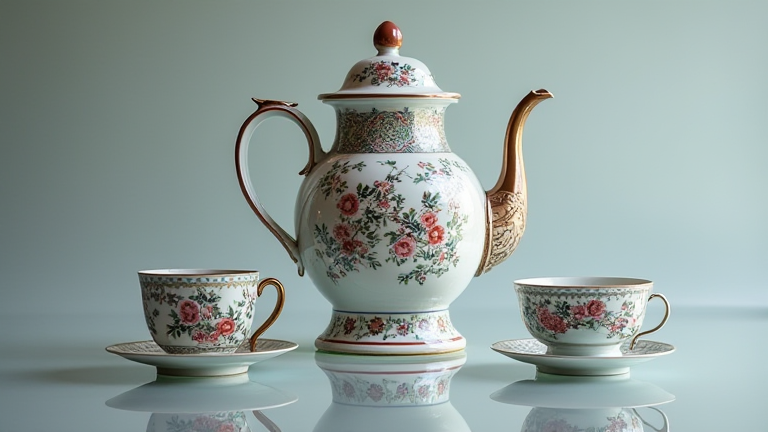
TL;DR: Porcelain’s global dominance wasn’t just about aesthetics—it was driven by five discrete tech leaps: high-fire kilns, cobalt underglaze, hard-paste replication, industrial molding, and digital 3D printing. Each breakthrough lowered cost, raised precision, or enabled new artistic languages, turning a Chinese imperial secret into a worldwide cultural substrate.
1. The Dragon Kiln (1,000°C+): The Birth of True Porcelain
Around 600 CE, Chinese potters in Yue and Xing kilns achieved sustained firing above 1,280°C using sloped “dragon kilns” that exploited natural draft. This was the first tech breakthrough—not a recipe but a thermal engineering feat. The result was vitrified, non-porous, translucent whiteware with a resonant ring, distinct from earthenware. Specs: feldspathic glaze fused with a kaolin-petuntse body, water absorption below 0.5%. Culturally, this allowed the Tang dynasty to export “china” as a luxury equivalent to gold, setting a global standard for purity that persists in lab-grade porcelain today.
If you want to dig deeper, check out our guide on Porcelain History & Culture: The Ultimate Beginner’s Guide.
2. Cobalt Underglaze (14th Century): The Blue-and-White Revolution
Persian cobalt oxide, imported via the Silk Road, was painted onto unfired porcelain then covered with a transparent glaze. The breakthrough was chemical stability—cobalt survives high fire without bleeding, unlike iron or copper. This enabled Yuan dynasty (1271–1368) production of the iconic blue-white pattern. Specs: cobalt concentration 2–5%, fired at 1,300°C, producing a deep sapphire hue that never fades. Industry impact: it created the world’s first mass-produced designer brand, copied from Istanbul to Delft, and standardized a visual language still used in tableware and tiles.
3. Meissen’s Hard-Paste Replication (1709): The End of the Chinese Monopoly
Johann Friedrich Böttger, under Augustus the Strong, reverse-engineered Chinese hard-paste porcelain using local kaolin from Aue (with alumina content >30%). The key spec was firing at 1,450°C with a feldspar flux, replacing the soft-paste (glass-frit) imitations that scratched easily. This breakthrough democratized production: European factories (Meissen, Sèvres, Wedgwood) could now make porcelain locally, collapsing trade deficits and triggering a century of industrial espionage. Culturally, it shifted porcelain from imperial gift to middle-class status symbol, enabling the Rococo and later Victorian tableware explosions.
4. Jasperware & Press Molding (1775): Precision at Scale
Josiah Wedgwood’s innovation wasn’t just the matte blue jasper body (barium sulfate with 0.2% cobalt) but the industrial use of plaster-of-Paris molds to press thin, identical reliefs. This cut labor time from days to minutes and allowed repeatable tolerances of ±0.1 mm. Industry impact: it birthed the ceramic factory system, with division of labor and quality control. For the first time, porcelain artifacts—medallions, dinner sets, architectural plaques—became reproducible commodities, fueling the British Empire’s export of “taste” and accelerating global consumer culture.
5. Digital 3D Printing & Laser Sintering (2015–Present): The New Porcelain Frontier
Modern breakthroughs are additive, not subtractive. Binder-jetting with alumina-silica powders (particle size 10–20 µm) followed by sintering at 1,350°C achieves 99.8% density—comparable to traditional porcelain but with no mold limits. Specs: layer height 25 µm, shrinkage controlled to ±1.5% via CAD compensation. Industry impact: designers now print lattice structures, undercuts, and internal channels impossible to cast. This has revived porcelain in medical ceramics (porous bone scaffolds) and ultra-thin tableware (0.8 mm walls). Culturally, it returns porcelain to
Leave a Reply