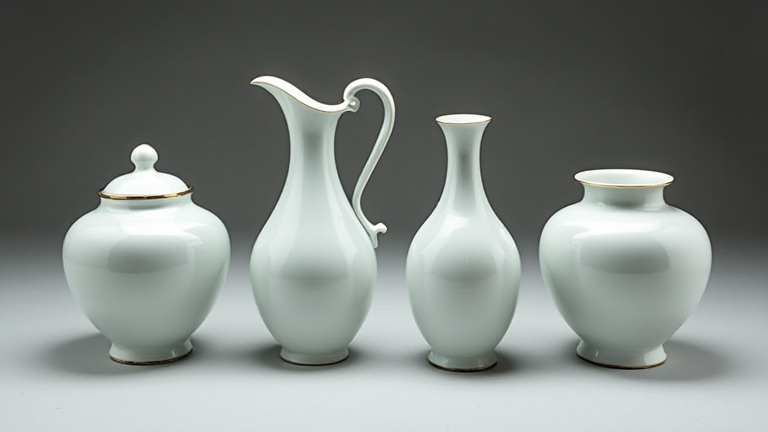
TL;DR: Porcelain, often called China’s “white gold,” is a high-fired ceramic defined by its translucency, hardness, and resonant ring—born from kaolin clay and feldspar at over 1,200°C. This guide explores its 1,000-year evolution from Tang dynasty prototypes to Ming masterpieces, and explains why its cultural and monetary value endures today.
Feature Highlights: The Craft That Shaped Civilizations
Porcelain’s defining features are not merely aesthetic—they are technical triumphs. True porcelain (hard-paste) contains kaolin, which allows it to vitrify into a non-porous, glass-like body. This gives it three hallmark traits: translucency (hold a thin bowl to light and see a ghostly glow), acoustic resonance (a sharp “ping” when tapped), and unmatched durability (resistant to chips, acids, and heat). For collectors, these features are testable. The finest examples—like Song dynasty Ru ware with its sky-blue crackle glaze—achieve a balance of form and glaze that no modern industrial ceramic can replicate. The cultural feature that sets porcelain apart is its role as a global currency: from the Silk Road to the Age of Sail, Chinese porcelain was traded ounce-for-ounce with silver, inspiring imitations in Persia, Japan, and Europe (think Meissen’s “white gold” of 1708).
If you want to dig deeper, check out our guide on Porcelain History: 5 Ancient Secrets & Cultural Trends.
Comparisons: Dynasty to Dynasty, Ware to Ware
To understand porcelain history, compare across eras. Tang dynasty (618–907) produced coarse, green-splashed sancai (three-color) wares—more earthenware than true porcelain. Song dynasty (960–1279) perfected monochrome glazes: Qingbai (shadow blue) and Jian (tea-fleck brown). The Ming dynasty (1368–1644) introduced cobalt underglaze blue-and-white, a style that became the world’s most copied ceramic. Compare a Ming Xuande jar with a Qing Kangxi vase: the former shows rough, unglazed foot rings and a painterly, organic blue; the latter exhibits crisp, machine-like precision and a deeper, purer cobalt. For modern buyers, the comparison extends to authenticity: antique Chinese porcelain (pre-1900) often shows kiln grit on the base, while modern reproductions have perfectly smooth finishes. European hard-paste (Meissen) is denser and colder to the touch, while Japanese Imari uses overglaze enamels for a busier, more colorful palette—a cultural fork that still defines collecting.
Why Culture Matters: More Than Decoration
Porcelain is not just a product; it is a historical document. Every piece encodes trade routes (the cargo of sunken junks), imperial edicts (Ming kilns at Jingdezhen were state-monopolized), and social rituals (the tea ceremony’s gaiwan). Owning a piece—even a shard—connects you to that narrative. Museums price imperial pieces in the millions, but entry-level collectors can still buy 18th-century export ware for under $500. The cultural value lies in provenance: a plate with a Dutch ship’s inventory mark is worth triple an unmarked twin. Your call-to-action is simple: don’t just read about porcelain—hold it. Visit a local antique dealer, ask to tap a Ming-style bowl, or order a modern Jingdezhen teacup. Start with a single piece that tells a story, and let the white gold teach you its history.
FAQ
Q: What is the single most important historical event in porcelain’s rise?
A: The establishment of the imperial kilns at Jing
Leave a Reply