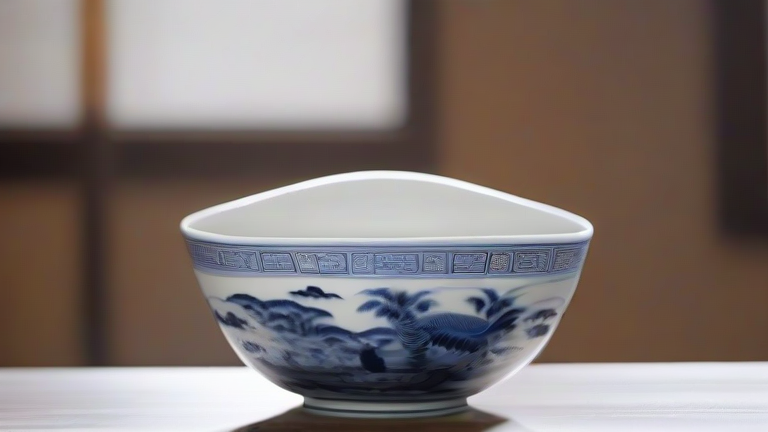
TL;DR: Porcelain is a high-fired ceramic born in China around 600–900 CE, prized for its translucency, hardness, and pure white body. To understand its culture, trace its evolution from imperial Chinese kilns to European “white gold” mania, then learn to identify key eras and styles by glaze, form, and decoration.
Step 1: Grasp the Chinese Origins (Tang to Ming)
Start with the Tang dynasty (618–907), where early “proto-porcelain” emerged from kaolin clay mixed with petuntse (feldspar), fired above 1,200°C. By the Song dynasty (960–1279), kilns at Jingdezhen perfected true porcelain—thin, resonant, and snow-white. Focus on three iconic Song styles: Qingbai (pale blue-white), Ding (ivory with carved floral motifs), and Longquan (celadon, a jade-green glaze). During the Yuan (1279–1368), cobalt-blue underglaze painting appeared, leading to the famous blue-and-white ware that would later conquer global markets. For the Ming (1368–1644), memorize the reign marks (e.g., Xuande, Jiajing) and the rise of export porcelain for Islamic and Southeast Asian courts.
If you want to dig deeper, check out our guide on **”Porcelain 2.0: How Tech Is Preserving Ancient Kilns & Cul.
Step 2: Trace the Silk Road and Maritime Trade
Porcelain was not just art—it was diplomatic currency. From the 9th century, Chinese ceramics traveled via the Silk Road to Persia and the Middle East, where Islamic potters copied the white body but could not replicate the firing temperature. By the 16th century, Portuguese ships carried porcelain to Europe, where it became a status symbol for royalty. Tip: Study the “Kraak” porcelain (late Ming) with its thin, fluted rims and paneled borders—it was the first mass-export style to reach the West, influencing Dutch Delftware and later English bone china.
Step 3: Understand the European “White Gold” Obsession
In 1708, Johann Friedrich Böttger at Meissen, Germany, finally cracked the formula for true hard-paste porcelain, ending China’s monopoly. Meissen’s early pieces were marked with crossed swords (1710 onward) and featured chinoiserie scenes, then evolved into Rococo floral patterns. For culture, note that porcelain became a political tool: Augustus the Strong of Saxony traded soldiers for porcelain vases, and Louis XV’s mistress Madame de Pompadour championed Sèvres porcelain in France. Learn the difference between hard-paste (high kaolin, fired at 1400°C) and soft-paste (glass frit, fired lower, more fragile—common in early English factories like Chelsea).
Step 4: Identify Cultural Signifiers in Decoration
Read the motifs. Chinese dragons (imperial power), phoenixes (empress), and lotus flowers (purity) have fixed meanings. European porcelain often used mythological scenes (Greek gods) or botanical illustrations—a nod to Enlightenment science. Tip: Check the foot rim. Chinese porcelain often has a gritty, unglazed ring; European pieces tend to have polished, glazed feet. For Japanese porcelain (Arita, Imari), the distinctive Kakiemon style—sparse, asymmetrical red, green, and blue motifs—was copied by Meissen and Chantilly. Never confuse Imari’s dense gold-overglaze with Kakiemon’s restraint.
Step 5: Practice with Museums and Auction Records
Visit a local museum’s Asian ceramics wing (or browse high-resolution online collections from the Met or the British Museum—no images needed here, just descriptions). Note the weight: genuine porcelain feels cold and dense. Tap it—a high, clear ring indicates vitrification. For culture, read auction catalogs (Christie’s or Sotheby’s) to see what collectors value: Ming blue-and-white vases often fetch millions, while 19th-century European “tourist” porcelain is
Leave a Reply