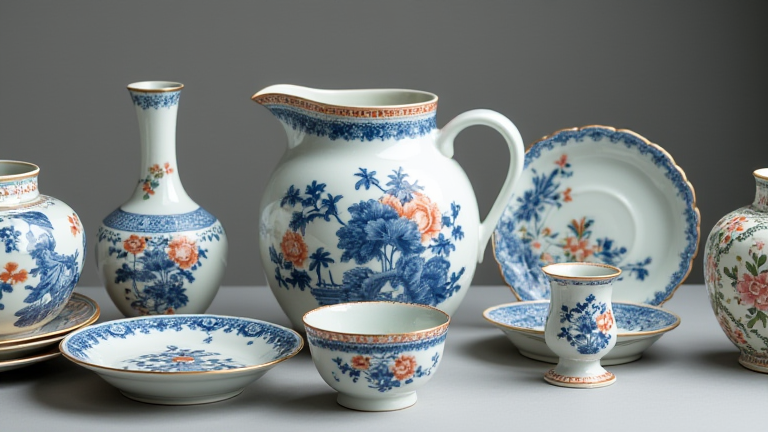
TL;DR: Porcelain is a high-fired, vitrified ceramic born in China around 600–900 CE, prized for its translucency, strength, and purity. To understand its culture, trace its evolution from imperial Chinese kilns to European “white gold” factories, and learn to identify key eras, techniques, and decorative motifs.
Step 1: Map the Chinese Origins (600–1700)
Begin with the Tang dynasty (618–907), where early “proto-porcelain” emerged in northern kilns. Then focus on the Song dynasty (960–1279) for the true breakthrough: pure kaolin clay and feldspathic glaze fired at 1,300°C. Visit the cultural heart at Jingdezhen, the “Porcelain Capital,” which produced imperial wares for the Yuan (Mongol) and Ming courts. For the Yuan (1271–1368), memorize the rise of blue-and-white—cobalt painted under a clear glaze, originally exported to the Islamic world. The Ming (1368–1644) cemented these styles, adding five-color (wucai) and monochrome glazes like sacrificial red and “sweet white.”
If you want to dig deeper, check out our guide on The Rich History & Culture of Porcelain: A Lifestyle Guide.
Step 2: Trace the Global Trade Routes
Porcelain was the first truly global luxury product. Study the Silk Road land routes and the Maritime Spice Route. From the 16th century, Portuguese and Dutch ships carried cargoes of blue-and-white to Europe, Africa, and the Middle East. Tip: look for “Kraak” porcelain—thin, lightly decorated wares with fluted rims—that flooded Europe and inspired local imitations. Also note the Japanese response: Arita kilns (Imari and Kakiemon styles) competed with China, especially after the Ming collapse in 1644 disrupted exports.
Step 3: Learn European Manufacturing (1700–1900)
Europe spent centuries trying to replicate Chinese porcelain. The breakthrough came in 1708 at Meissen, Germany, under Johann Friedrich Böttger. Key milestones to memorize: Meissen’s crossed-swords mark (1720s), Sèvres in France (soft-paste, later hard-paste), and Wedgwood’s creamware in England (1760s). For culture, understand that porcelain became a status symbol—kings built “porcelain rooms” (e.g., the Japanese Palace in Dresden). Tip: identify European wares by their paste (soft vs. hard), glaze tone, and decorative motifs like chinoiserie (fake Asian scenes) or neoclassical patterns.
Step 4: Read the Cultural Codes in Decoration
Porcelain is a language of symbols. In Chinese culture, dragons (power), phoenixes (empress), and bats (fortune) carry specific meanings. Blue-and-white’s cobalt came from Persia, but the motifs were Chinese—lotus, clouds, and scholars. In European wares, look for armorial crests (noble commissions), botanical illustrations (Enlightenment science), and pastoral scenes (Rococo fantasy). Tip: compare the base—unfinished foot rims often reveal age; Ming bases have a gritty, sandy texture, while Meissen bases are smooth and polished.
Step 5: Handle and Authenticate Like a Pro
When examining a piece, start with the “ping”—tap it gently. True porcelain rings with a clear, metallic tone. Hold it to light: genuine translucent wares show a soft glow. Check the weight: porcelain is denser than earthenware but lighter than stoneware. Inspect the glaze: old Chinese glazes have slight “orange peel” texture and tiny bubbles. For marks, use a loupe (10x) to look for hand-painted vs. printed details. Never wash antique porcelain in a dishwasher; use lukewarm water and a soft brush. Store pieces with felt separators to avoid chips.
Step 6: Build a Beginner’s Collection on a Budget
Start with 19th-century European “whiteware” or Chinese export pieces from the Republic period (
Leave a Reply