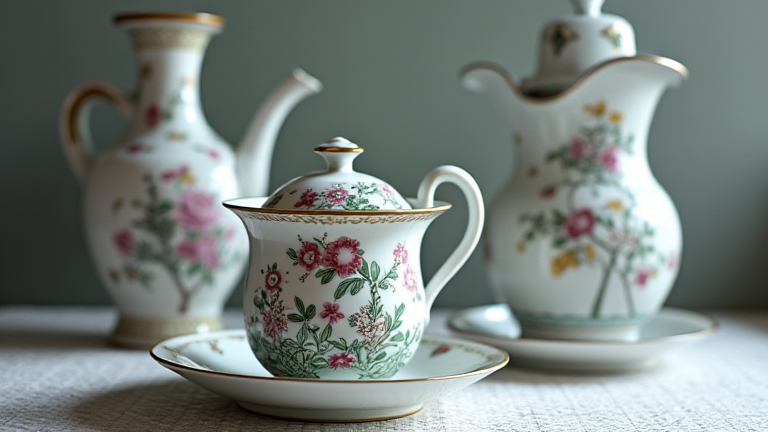
TL;DR: Porcelain is a high-fired, vitrified ceramic born in China around 600–900 CE, prized for its strength, translucency, and white body. To understand its culture, trace its evolution from imperial Chinese kilns to European “white gold” mania, then learn to identify key periods and styles.
Step 1: Understand the Material & Its Chinese Origins
Porcelain is made from kaolin clay and petuntse (feldspar), fired at 1,200–1,400°C until glassy. Begin by memorizing the three dynastic milestones: Tang (618–907) for early whiteware, Song (960–1279) for celadon and qingbai (shadow-blue), and Ming (1368–1644) for the iconic blue-and-white underglaze. Tip: Visit a museum collection online (e.g., the Met or British Museum) and zoom into the foot rims—un-glazed, gritty bottoms indicate pre-18th-century Chinese pieces.
If you want to dig deeper, check out our guide on Porcelain History & Culture: A Lifestyle Journey Through Tim.
Step 2: Trace the Silk Road & Islamic Adaptation
By the 9th century, Chinese porcelain reached the Abbasid Caliphate, where potters in Iraq attempted imitation (fritware). Study how Islamic artisans added cobalt from Persia, which later returned to China as “Mohammedan blue.” Tip: Compare a Ming blue-and-white dish with a 12th-century Persian fritware bowl—note the Chinese use of dense, layered patterns vs. Islamic geometric symmetry.
Step 3: The European “White Gold” Craze & Imitation
Portuguese traders introduced porcelain to Europe in the 16th century. Nobles called it “white gold” and displayed it in cabinets. The breakthrough came in 1708 when Johann Böttger at Meissen, Germany, produced true hard-paste porcelain. Tip: Look for the crossed-swords mark on Meissen pieces (after 1720) and the soft-paste (bone ash) difference—tap gently: hard-paste rings, soft-paste thuds.
Step 4: Identify Cultural Signifiers in Decoration
Patterns carry meaning: dragons (imperial power), phoenixes (empress), lotus (purity), and the “Eight Immortals” (Daoist legends). For European pieces, check for chinoiserie—fantastical Asian scenes that reveal Western imagination, not reality. Tip: A blue-and-white willow pattern (English, 1790s) is NOT Chinese—it’s a British invention narrating a lovers’ tale.
Step 5: Care, Collecting & Ethics
Start with shards or 19th-century export pieces (under $100) before buying antiques. Always verify provenance—many “vintage” pieces are 20th-century Japanese or French reproductions. For care: hand-wash with mild soap, never in a dishwasher; avoid thermal shock (no boiling water into cold porcelain). Tip: Use a UV flashlight—crazing (fine cracks) under UV reveals age or repair.
FAQ
Q: What’s the difference between porcelain, china, and bone china?
A: “Porcelain” and “china” are synonyms for hard-paste (kaolin-based). Bone china, invented in England (1790s), adds 30–50% bone ash for extra whiteness and chip resistance—it’s softer, not true porcelain.
Q: How can I tell if a piece is genuinely antique without a certificate?
A: Check the base: pre-1900 pieces have unglazed rims, irregular glaze pooling, and hand-painted (slightly uneven) cobalt. Also, hold it to light—true antique porcelain is translucent at the thinnest edges; fake “porcelain” often looks opaque.
Q: Why do some porcelain pieces develop tiny cracks (crazing)?
A: Crazing happens when the glaze cools faster than the clay body,
Leave a Reply