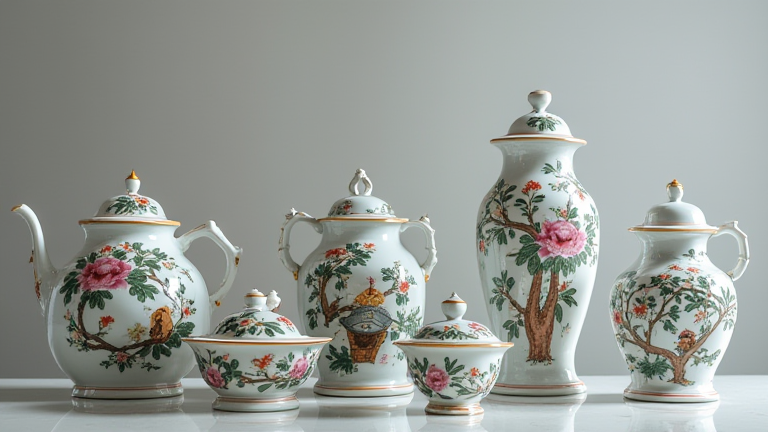
TL;DR: Porcelain is a high-fired, vitrified ceramic born in China around 600–900 CE, prized for its strength, translucency, and pure white body. To understand its culture, trace its evolution from imperial Chinese kilns to European “white gold” factories, and learn to identify key periods, styles, and production techniques.
Step 1: Start with the Chinese Origins (Tang to Ming Dynasties)
Begin your journey in the kilns of Jingdezhen, the “Porcelain Capital.” During the Tang dynasty (618–907), artisans perfected true porcelain by mixing kaolin (white clay) with petuntse (feldspathic rock) and firing at 1,280–1,400°C. For production, the key milestone is the Song dynasty (960–1279), which introduced celadon glazes and the iconic bluish-white *qingbai* ware. By the Ming dynasty (1368–1644), cobalt-blue underglaze decoration became the global signature—study the distinct deep blue of “Ming blue” and the thin, eggshell-like bodies of *doucai* (contrasting colors).
Step 2: Trace the Silk Road and Maritime Trade
Porcelain was not just art—it was a global currency. From the 9th century, Chinese ware traveled via the Silk Road to Persia, then to the Middle East and Africa. By the 16th century, Portuguese and Dutch ships carried cargoes of blue-and-white porcelain to Europe, where it was called “white gold” and mounted in silver for nobility. To understand cultural impact, note that Persian and Ottoman potters imitated Chinese motifs, while Japanese Arita kilns (early 17th century) produced “Imari” and “Kakiemon” styles specifically for export to Europe.
Step 3: Decode the European Revolution (18th Century)
Europe’s obsession led to a centuries-long quest to reverse-engineer the recipe. In 1709, Johann Friedrich Böttger at Meissen, Germany, finally produced hard-paste porcelain, sparking a continent-wide industry. Key cultural shifts: Meissen’s trademark crossed swords (1720), Sèvres’ soft-paste with luxurious pink and blue grounds (1756), and Wedgwood’s mass-produced creamware (1760s) that democratized porcelain for the middle class. For collectors, distinguish “hard-paste” (true porcelain, like Chinese) from “soft-paste” (frit-based, easier to scratch) by tapping the rim—hard-paste rings clearly.
Step 4: Identify Hallmarks and Period Styles
Look for underglaze marks on the base (reign marks, factory logos, or painter’s initials). For Chinese pieces, learn the six-character reign marks (e.g., “Da Ming Wanli Nian Zhi” = made in Wanli period). For European, check for incised or painted factory marks. Culturally, note the Rococo influence (asymmetrical scrolls, gold) versus Neoclassical (clean lines, cameo motifs). Always use a loupe to inspect the glaze—genuine antique porcelain shows “crazing” (fine hairline cracks) from age, while modern reproductions have glassy-smooth surfaces.
Step 5: Care and Display as a Cultural Practice
Treat porcelain as fragile history. Wash pieces by hand with mild soap and a soft sponge—never in a dishwasher. Display away from direct sunlight to prevent glaze fading. For cultural appreciation, group pieces by theme (e.g., famille rose vs. blue-and-white) and use museum putty to secure them. To test authenticity at home, hold a piece to light: authentic thin porcelain shows a warm amber translucency, while fakes are opaque.
FAQ
Q: What is the single most important difference between porcelain and pottery?
A: Porcelain is fired at a much higher temperature (over 1,200°C) and contains kaolin, making it non
Leave a Reply