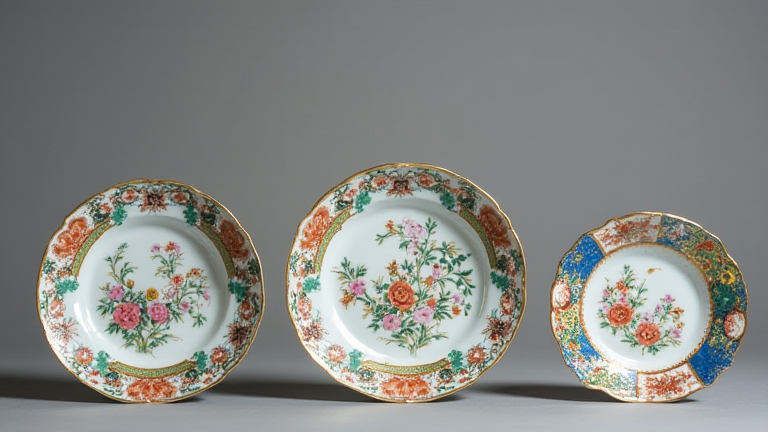
TL;DR: Porcelain, born in China over a millennium ago, is not just ceramic—it is a frozen timeline of trade, imperial power, and artistic rebellion. This guide unpacks its evolution, from Tang dynasty experiments to Meissen’s European coup, and shows you how to identify, value, and collect pieces with cultural confidence.
Feature Highlights: Why Porcelain Matters Beyond the Cabinet
Porcelain’s magic lies in its dual identity: a technical marvel (fired at 1,300°C, vitrified and translucent) and a cultural cipher. The first highlight is material provenance—true hard-paste porcelain requires kaolin and petuntse, a recipe China held as a state secret for centuries. The second highlight is decorative language: cobalt blue-and-white (Yuan dynasty, 14th century) tells stories of Mongol trade routes, while famille rose (Qing, 18th century) reveals European enamel influences. Third, marks and reign periods—a six-character Jiajing mark can triple a vase’s value, but only if you know the brushstroke quirks. Finally, consider cultural transmission: Japanese Imari, German Meissen, and French Sèvres each remixed Chinese forms, creating a global “porcelain dialogue” that collectors chase today.
If you want to dig deeper, check out our guide on Porcelain History: 7 Trends Reshaping Culture & Art.
Comparisons: Ming vs. Qing, and Chinese vs. European Porcelain
When comparing Ming (1368–1644) vs. Qing (1644–1912) porcelain, focus on body and glaze. Ming pieces are often heavier, with a creamy, unctuous glaze and freehand cobalt that bleeds slightly (the famous “heaped and piled” effect). Qing pieces—especially under Kangxi and Qianlong—are thinner, brighter, and technically perfect, with polychrome enamels and intricate gilding. For the collector, Ming offers raw, expressive charm; Qing offers precision and opulence. Now compare Chinese export porcelain vs. European Meissen: Chinese export ware (17th–19th c.) used mass-produced “Kraak” patterns, often with armorial crests for Western buyers, while Meissen (starting 1710) invented its own hard-paste recipe and produced figures like the iconic “Monkey Orchestra” with playful asymmetry. Chinese pieces are historically deeper; Meissen pieces are rarer in early examples and command higher auction prices per ounce. A third comparison: underglaze blue (cobalt painted before glazing, then fired) vs. overglaze enamel (painted on fired glaze, then re-fired at lower temp). Underglaze blue is durable and classic; overglaze enamel (like famille verte) is fragile but visually richer—which explains why Qing polychrome pieces demand careful handling and often cost 20–30% more than comparable blue-and-white.
Collecting Strategy & Call-to-Action
Start with shards or 19th-century “provincial” wares (under $100) to learn glaze textures. Then, invest in one authenticated Qing blue-and-white dish with a clear provenance—that’s your anchor piece. Do not buy “mystery” vases without a loupe; check for firing cracks, repair lines, and mark consistency. For culture, read “The Hare with Amber Eyes” or visit the Victoria & Albert Museum’s ceramic galleries online. Your next step: Write down your budget and pick one dynasty to focus on. Then, visit a reputable auction house (Christie’s or Bonhams) and request a condition report on a lot you admire. Join a porcelain collector’s forum—ask for second opinions on your photos. Do not wait; the market for pre-1900 porcelain is stable and historically undervalued compared to paintings. Start your collection this week by purchasing a reference book (e.g., “Chinese Porcelain: A New History”)—and handle your first piece with white cotton gloves
Leave a Reply