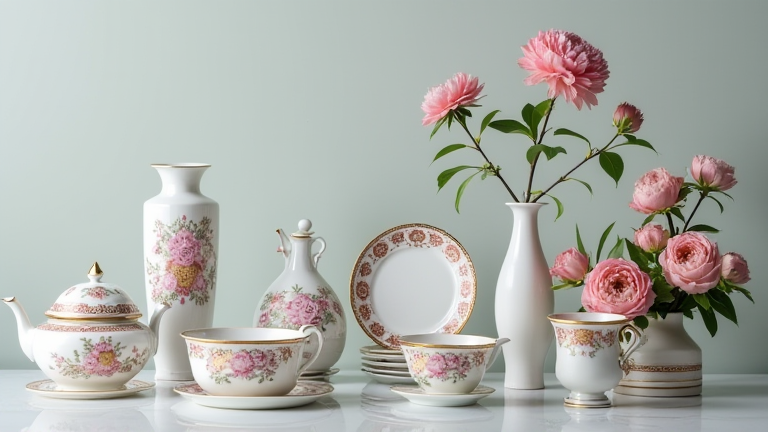
TL;DR: Porcelain is more than delicate dinnerware—it’s a 1,000-year-old story of imperial trade, technological rebellion, and cross-cultural obsession. From Chinese kilns to European royal courts, this craft shaped economies and aesthetics, and its legacy lives on in modern tabletop design and collectible culture.
The Birth of “White Gold” in Ancient China
Long before it graced Parisian salons, porcelain was a closely guarded secret of the Tang and Song dynasties. Around the 7th century, Chinese potters in Jingdezhen discovered that a specific blend of kaolin clay and petuntse stone, fired at over 1,300°C, produced a hard, translucent, and ringing material unlike any pottery before it. The result was a surface so smooth and white that it mimicked jade—the most revered stone in Chinese culture. By the Yuan dynasty (1271–1368), blue-and-white porcelain, painted with cobalt imported from Persia, became the first global luxury product. Arab traders carried it to the Middle East, where it was called al-sini (“from China”), and Venetian merchants brought it to Europe, where it was valued above gold. For centuries, no one outside Asia could replicate the formula, and porcelain became a symbol of wealth, diplomacy, and power—a “white gold” that funded emperors and sparked espionage.
If you want to dig deeper, check out our guide on Porcelain History & Culture: A Guide to China’s White Gold.
The European Obsession and the Birth of Meissen
Europe’s craving for porcelain was so intense that alchemists and chemists spent two centuries trying to crack the code. In 1708, Johann Friedrich Böttger, a Saxon alchemist under the patronage of Augustus the Strong, finally succeeded in Dresden, producing the first true hard-paste porcelain outside Asia. This led to the founding of the Meissen factory in 1710, which quickly became the template for royal manufactories across Europe—from Sèvres in France to Imperial Porcelain in Russia. But the obsession wasn’t just about ownership; it was about cultural appropriation and reinvention. Meissen’s artisans developed their own motifs, like the famous crossed swords and the “onion pattern,” which borrowed Chinese floral aesthetics but twisted them into distinctly European forms. Meanwhile, the Dutch East India Company imported millions of pieces of Chinese and Japanese export porcelain, shaping European dining rituals. By the 18th century, a proper tea service wasn’t just a vessel for tea—it was a statement of refinement, etiquette, and social standing. Porcelain had transformed from a trade commodity into a medium for identity.
Porcelain as a Living Culture Today
Fast forward to the 21st century, and porcelain culture is no longer confined to museum vitrines. The craft has undergone a renaissance, blending ancient techniques with modern design. Independent studios from Copenhagen to Kyoto are reviving hand-painting traditions, while contemporary artists use porcelain to explore themes of fragility, memory, and globalization. For the lifestyle enthusiast, porcelain is now a personal growth tool: collecting a single hand-thrown bowl encourages mindfulness, while hosting a dinner on heirloom plates fosters connection over perfection. Travelers can visit Jingdezhen’s living ceramic villages, where artisans still fire kilns with wood, or tour the Meissen factory to watch craftspeople paint miniature roses. And in the age of fast fashion, the deliberate slowness of porcelain—its need for patience, precision, and respect for material—offers a counterbalance to disposable culture. Whether you’re sipping espresso from a vintage Limoges cup or commissioning a custom teapot, you’re participating in a dialogue that spans continents and centuries. Porcelain is not just an object; it’s a philosophy of beauty, durability, and cultural exchange that invites you to slow down and appreciate the art of the everyday.
FAQ
Q: What makes porcelain different from regular ceramic or stoneware?
A: Porcelain is fired at much higher temperatures (above 1,200°C) and uses kaolin clay, which makes it denser, whiter, and more translucent than stoneware or earthenware. It’s also non-por
Leave a Reply