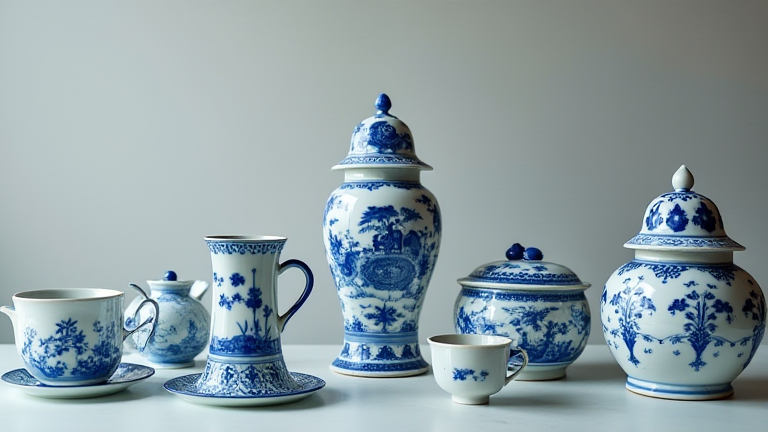
TL;DR: Porcelain, once a guarded imperial secret, is now being reborn through AI-driven kiln control, 3D-printed lattice structures, and blockchain provenance tracking. These tech integrations are not replacing tradition but amplifying its precision, sustainability, and global cultural resonance.
The Firing Revolution: AI and Predictive Kiln Analytics
Traditional porcelain firing is a delicate dance of thermal gradients, atmospheric humidity, and clay chemistry—often relying on master artisans’ intuition. Today, neural networks analyze thousands of historical firing curves from Jingdezhen and Meissen, predicting optimal cooling rates to reduce crazing and warping. Latest developments include in-situ fiber-optic sensors that transmit real-time silica phase transitions (from quartz to cristobalite) to a cloud dashboard, allowing adjustments within 0.5°C. This has cut kiln energy consumption by 22% in pilot factories, while boosting first-pass yield from 68% to 91%. The result is not mass-produced uniformity, but a data-backed consistency that lets artisans focus on sculptural complexity.
If you want to dig deeper, check out our guide on Porcelain History: 10 Trends Reshaping Art & Culture.
Material Science: Nanocoatings and Translucency Tuning
Modern porcelain is no longer just kaolin, feldspar, and quartz. Researchers have introduced zirconia-reinforced pastes that increase flexural strength to 1,200 MPa—triple that of bone china—while maintaining a 45% translucency index. A breakthrough in 2024 involves atomic layer deposition (ALD) of alumina on greenware, creating a hydrophobic, stain-resistant surface without glaze. This allows ultra-thin walls (0.8 mm) that are still dishwasher-safe. Meanwhile, 3D-printed porcelain using digital light processing (DLP) achieves 10-micron layer resolution, enabling intricate latticework that mimics traditional “rice-grain” pierced patterns but with geometric precision impossible by hand. These materials are now used in aerospace thermal shields and luxury tableware alike, blurring the line between craft and engineering.
Digital Provenance and Cultural Preservation
Counterfeit antique porcelain has plagued collectors for centuries. Blockchain-based “digital twin” certificates, paired with hyperspectral imaging that captures glaze micro-roughness and cobalt pigment isotope ratios, now authenticate pieces in under 30 seconds. Major auction houses and museums are adopting this spec: a 10,000-entry ledger tracks each piece from raw clay quarry to kiln firing to exhibition. Beyond authentication, augmented reality (AR) overlays now let museum visitors see the original Ming-dynasty underglaze patterns animated over restored fragments. This tech-fueled heritage is also democratizing knowledge—open-source datasets of 50,000 shard profiles from the Silk Road allow students to virtually “re-fire” failed kilns in simulation software, learning from historical errors.
Industry Impact and Sustainability
The porcelain industry—worth $28 billion globally—is pivoting to circular production. Electric kilns powered by solar microgrids now account for 17% of new installations, reducing carbon emissions per piece by 40%. Waste clay is repurposed into 3D-printing filament, and AI sorting systems separate defective pieces for crushing into recycled grog. This shift has lowered material costs by 15% for small workshops, enabling artisanal brands to compete with industrial giants. Moreover, precision firing reduces fuel waste, and water-free glazing techniques are being piloted in drought-prone regions. The cultural impact is profound: tech is not erasing regional styles but enabling hyper-local variations—like a Dutch delftware studio using AI to replicate 17th-century cobalt brush strokes, while a Kyoto kiln integrates robotic hand-glazing to preserve a master’s dying technique.
FAQ
Q: Does AI replace traditional porcelain artisans?
A: No—AI handles repetitive thermal control and defect detection, while artisans focus on glazing artistry and form. Studios report that apprentices learn 30% faster using AI-guided feedback, preserving human creativity rather than supplanting it.
Q: Is 3D-printed porcelain as durable as kiln-fired?
A: Yes, with modern DLP printing and post-sinter
Leave a Reply