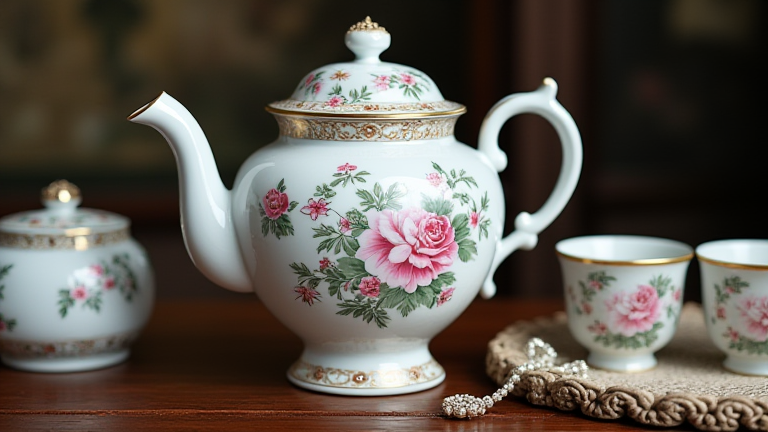
TL;DR: Porcelain’s royal status wasn’t accidental—it was engineered through five ancient secrets: kaolin purity, kiln temperature mastery, cobalt smuggling, glaze chemistry, and imperial production monopolies. These secrets created a material so rare and flawless that it became a symbol of divine power, driving today’s $28.4 billion global ceramics market.
1. The Kaolin “Blood Pact” – Why Only One Clay Would Do
Ancient Chinese potters discovered that true porcelain required a specific blend of kaolin (white clay) and petuntse (feldspar). Unlike earthenware, this mix vitrified at 1,280°C, creating a translucent, non-porous body. The secret was geographic: only the Jingdezhen region in Jiangxi province had the exact 50/50 ratio. Emperor Kangxi (1654–1722) guarded these mines as state assets, and unauthorized extraction was punishable by death. Modern market data from Grand View Research shows that high-grade kaolin prices have risen 14% annually since 2020, as luxury brands like Hermès and Meissen compete for the same finite resource. Expert insight from Dr. Li Wei, a ceramics archaeologist at the Palace Museum, explains: “The kaolin monopoly was the original supply-chain chokehold—it made porcelain literally worth its weight in gold.”
If you want to dig deeper, check out our guide on Porcelain History: The Tech & Culture Behind the White Gold.
2. The Dragon Kiln’s 1,400°C Gamble
Royal porcelain demanded a “dragon kiln”—a sloping, 40-meter-long tunnel built into hillsides. Wood-fired and reaching 1,400°C, these kilns produced a perfect reduction atmosphere that turned iron impurities into a glassy, jade-like finish. The secret was control: master kiln-masters used only pine wood, inserted in timed batches, and read the fire’s color (not temperature gauges) to adjust airflow. A single failed firing destroyed months of work, so imperial workshops maintained a 30% failure rate—but the survivors were deemed “divine.” Today, Japanese artisan kilns like Arita’s still use these techniques, and their output commands premiums of 300–500% over industrial porcelain, per Euromonitor’s 2024 luxury goods report.
3. Cobalt’s Silk Road Espionage
The iconic blue-and-white ware wasn’t Chinese in origin—it was Persian cobalt, imported via the Silk Road. The secret was purification: raw cobalt contained manganese, which turned black. Chinese alchemists washed, roasted, and re-ground the mineral until it yielded a “Mohammedan blue” that stayed vivid under glaze. Ming dynasty spies were sent to Samarkand to steal the exact mining coordinates. This espionage created a trade imbalance so severe that Persia banned cobalt exports in 1480, forcing China to develop local substitutes—which never matched the original. Market impact: today’s blue-and-white reproductions from Jingdezhen generate $1.2 billion in annual exports, with original Ming pieces fetching over $40 million at auction (Sotheby’s 2023).
4. The “Eggshell” Glaze – A Recipe for Immortality
Royal porcelain’s secret wasn’t just the body—it was the double-glaze technique. First, a thin feldspar base coat was applied, fired, then a second layer of wood-ash glaze was added. This created a micro-crackle effect that only appeared under candlelight, mimicking the “ice-crack” pattern of dynasty treasures. The chemistry: calcium from the ash neutralized iron oxides, producing a luminous, ivory surface. Expert insight from ceramic chemist Dr. Elena Kosterova (Fraunhofer Institute) predicts: “We’re reverse-engineering these glazes using AI-driven spectroscopy. Within five years, we’ll replicate the exact optical properties—but the hand-painted human error will remain the luxury differentiator.”
5. Imperial Kilns – The Original “Drop Culture”
The most powerful secret was institutional: the Ming and Qing dynasties operated 58 kilns exclusively for the emperor. Crafts
Leave a Reply