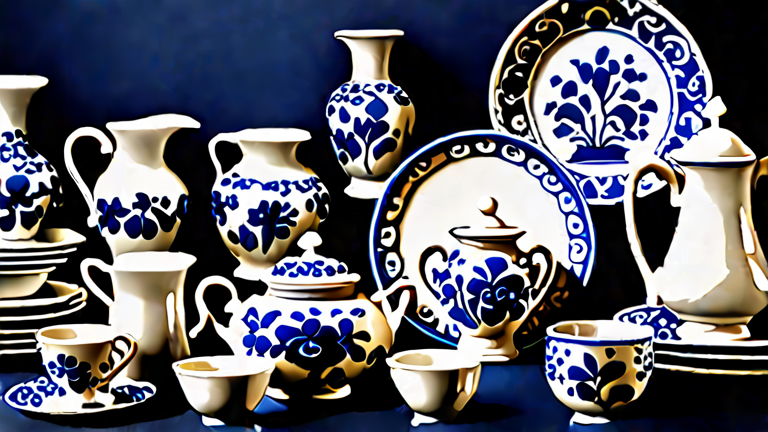
TL;DR: Porcelain is a high-fired ceramic born in China around 600–900 CE, prized for its translucency, hardness, and white body. To understand it, trace its evolution from Tang dynasty wares to European “white gold” factories, then learn to identify key cultural markers like blue-and-white patterns and kiln-specific glazes.
Step 1: Know the Three Essential Ingredients
Porcelain is not just any clay. It requires kaolin (white clay), feldspar (flux), and quartz (silica). Fired at 1,200–1,400°C, these fuse into a glassy, non-porous body. Unlike earthenware or stoneware, porcelain rings like a bell when tapped. For a beginner, memorize this triad—it explains why only certain regions (China, Japan, Germany, France) became porcelain hubs.
If you want to dig deeper, check out our guide on Porcelain Through the Ages: A Business Guide to China’s Time.
Step 2: Trace the Timeline (China’s 1,000-Year Head Start)
Start with Tang dynasty (618–907) “proto-porcelain” (white, but not fully vitrified). Move to Song dynasty (960–1279) for true porcelain: the iconic qingbai (shadow-blue) and ding white wares. Then jump to Yuan dynasty (1271–1368) when cobalt from Persia created the world-famous blue-and-white porcelain, exported along the Silk Road. Finally, Ming (1368–1644) and Qing (1644–1912) perfected imperial kilns at Jingdezhen—the “Porcelain Capital.”
Step 3: Understand European “Discovery” and Imitation
Porcelain reached Europe via trade in the 14th century, but the secret of kaolin remained Chinese. In 1708, Johann Böttger at Meissen (Germany) cracked the formula, producing hard-paste porcelain. Soon, Sèvres (France), Wedgwood (England), and others followed. For culture, note that early European pieces were often “chinoiserie”—fantastical Asian-inspired designs, not accurate copies. This cross-cultural blend is key to museums today.
Step 4: Identify Cultural Markers (Patterns & Glazes)
Look for these signposts:
– Blue-and-white: Cobalt underglaze—Chinese Yuan/Ming, later Dutch Delft (tin-glazed earthenware, not true porcelain).
– Famille rose/verte: Qing-era overglaze enamels (pink, green)—very collectible.
– Celadon: Jade-green glaze (Song dynasty) that mimics nephrite jade, valued for its subtle, crackled surface.
– Kraak porcelain: Late Ming export ware with thin, paneled rims—the first mass-produced Chinese porcelain for Europe.
Step 5: Handle, Date, and Care for Pieces
To avoid fakes, check the foot rim: genuine antique porcelain shows unglazed, slightly gritty edges (from kiln supports). Test translucency by holding a thin rim to light—Chinese porcelain glows warm orange, European hard-paste glows cool white. For care, never use dishwasher or abrasive cleaners. Wash by hand with mild soap, and store with acid-free tissue between stacked plates. Always lift by the body, not the handle—handles are often re-glued.
Step 6: Visit Collections or Start a Small Budget Collection
Begin with 19th-century European “parian” (statuary porcelain) or 20th-century Japanese Noritake—both affordable ($20–$100). For culture, visit the Victoria & Albert Museum (London) or the Palace Museum (Beijing) online. Join a local ceramics club to handle shards. Read “Porcelain: A History” by Nigel Wood for depth.
FAQ
Q: What is the
Leave a Reply