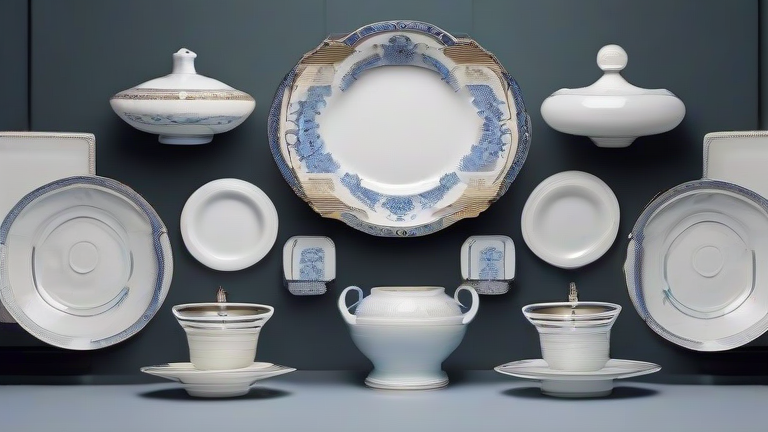
TL;DR: Porcelain technology has evolved from ancient alchemical secrets to industrial precision, with modern advancements focusing on digital 3D printing and nano-composite formulations. These innovations are reshaping the cultural landscape by enabling mass customization while preserving historical authenticity through high-resolution data preservation.
The Digital Resurrection of Ancient Craft
Porcelain, often termed “white gold,” has a history spanning over a thousand years, originating in China. Today, the intersection of heritage and technology is creating a new era for this material. The latest developments in the industry are not merely about manufacturing; they are about preserving cultural integrity through digital means. Major museums and heritage sites are now utilizing photogrammetry and high-resolution 3D scanning to create digital twins of ancient porcelain pieces. This technology allows for the creation of exact replicas for educational purposes without risking damage to the originals. The specs of these digital models include sub-millimeter accuracy, capturing every crack, glaze variation, and brushstroke detail. This level of precision is critical for conservationists who need to understand the structural integrity of fragile historical artifacts. By analyzing the thermal expansion coefficients and chemical compositions via X-ray fluorescence spectroscopy, researchers can now recommend specific preservation environments that prevent degradation. The industry impact is profound, as it shifts the focus from physical scarcity to digital abundance, allowing global audiences to interact with rare pieces virtually.
If you want to dig deeper, check out our guide on The Enduring Allure of Porcelain: A Journey Through History.
Material Science and Modern Manufacturing
Beyond preservation, the production of modern porcelain is undergoing a technological revolution. Traditional kilns are being replaced by computer-controlled firing chambers that monitor temperature and atmosphere in real-time. These systems use IoT sensors to adjust gas flow and oxygen levels, ensuring uniform firing results that were previously dependent on the potter’s intuition. The latest specs for industrial porcelain include the integration of nano-silica and titanium dioxide, which enhance durability and resistance to thermal shock. These materials allow for thinner, lighter, yet stronger vessels, reducing shipping weights and environmental footprints. Furthermore, digital fabrication techniques such as Fused Deposition Modeling (FDM) are being adapted for ceramic pastes. This allows for the creation of complex geometric structures that are impossible to achieve through traditional hand-throwing. Artists and designers are using this technology to explore new aesthetic frontiers, blending historical motifs with futuristic forms. The cultural impact is significant, as it democratizes access to high-quality porcelain. Consumers can now order custom-designed pieces online, which are then 3D printed and fired in local facilities, reducing lead times and carbon emissions associated with long-distance shipping.
Industry Impact and Future Trends
The convergence of history and tech is driving significant economic changes. The market for “tech-enabled” porcelain is growing, with a particular surge in demand for personalized items that feature historical patterns. Brands are leveraging AI to analyze historical archives and suggest design combinations that resonate with contemporary tastes. This data-driven approach ensures that new products remain culturally relevant while appealing to modern sensibilities. Additionally, the supply chain is becoming more transparent through blockchain technology. Each piece of porcelain can be traced from the source of the raw clay to the final consumer, verifying its authenticity and ethical sourcing. This transparency is crucial for high-end collectors and institutions that require provenance documentation. Looking ahead, the integration of augmented reality (AR) is expected to transform how consumers engage with porcelain. Users will be able to point their smartphones at a piece to see its historical context, the biography of the artist, or the specific firing process used. This immersive experience deepens the cultural connection, making porcelain not just a functional object but a storytelling medium. The industry must continue to balance innovation with tradition, ensuring that the soul of the craft is not lost in the digital age.
FAQ
Q: How does 3D scanning help preserve ancient porcelain?
A: It creates precise digital twins that allow for study and replication without handling fragile originals.
Q: What new materials are being used in modern porcelain production?
A: Nano-silica and titanium dioxide are added to improve strength and thermal shock resistance.
Q: How is blockchain impacting the porcelain market?
A: It provides a transparent, immutable record of provenance and
Leave a Reply