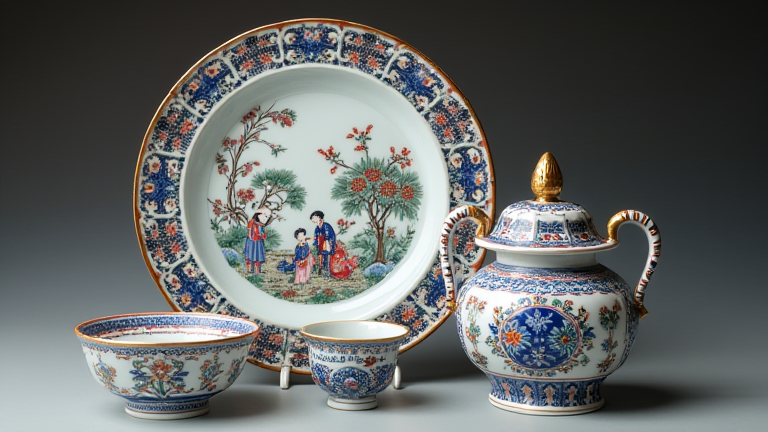
Porcelain History: 7 Facts on Culture & Craft
TL;DR: Porcelain has shaped global trade and culture for over a thousand years, originating in China before spreading to Europe and beyond. Understanding its history reveals the intricate blend of artistic innovation, geological science, and economic power that defines this unique ceramic material today.
The story of porcelain is not merely about white clay and fire; it is a narrative of human ingenuity, geopolitical shifts, and aesthetic evolution. For collectors, historians, and enthusiasts of fine arts, understanding the background of this material adds profound depth to every piece owned or admired. This article explores seven critical facts that illuminate the cultural and craft significance of porcelain, helping you appreciate why it remains a coveted material in modern design and historical study.
If you want to dig deeper, check out our guide on Porcelain History: 7 Cultural Trends Shaping Modern Art.
The Origins of the White Gold
First, we must look to ancient China, specifically the Longquan kilns, where true porcelain was mastered as early as the Shang Dynasty, though it reached its peak during the Tang and Song dynasties. The term “porcelain” itself is often attributed to Marco Polo, who described the material as “white gold” due to its translucency and strength. This initial discovery was a state secret, guarded jealously by Chinese artisans for centuries, making it a symbol of imperial power and refinement. The exclusivity of the material meant that only the elite could afford tableware and decorative items, establishing porcelain as a status symbol that transcended mere utility.
European Imitations and Breakthroughs
Secondly, the European quest to replicate Chinese porcelain drove centuries of experimentation. Alchemists and potters in Germany, Italy, and France attempted to create a similar material using local clays and feldspar. The breakthrough came in 1709 in Meissen, Germany, when Johann Friedrich Böttger successfully created hard-paste porcelain under the patronage of Augustus the Strong. This event marked the end of China’s monopoly and the beginning of a global porcelain industry. Meissen quickly became the most sought-after brand in Europe, leading to the development of distinct European styles that would influence global aesthetics for centuries. The rivalry between Meissen and later Sèvres in France created a dynamic landscape of innovation, where each region developed unique glazing techniques and decorative motifs.
Cultural Symbolism and Trade
Thirdly, porcelain served as a crucial medium for cultural exchange along the Silk Road and maritime trade routes. Chinese export porcelain, often featuring cobalt blue patterns, was highly prized in the Middle East, Africa, and Europe. These vessels were frequently used to store spices, silks, and other valuable goods, embedding the material into the daily lives of diverse cultures. The patterns themselves often carried symbolic meanings, such as dragons representing imperial power or lotus flowers signifying purity. When European factories began producing their own wares, they adapted these motifs, leading to a fascinating cross-pollination of artistic styles. Today, reproductions of these trade pieces are popular among collectors who wish to understand the interconnectedness of global history through material culture.
Technological Advancements in Craft
Fourth, the craft of porcelain has evolved through significant technological advancements. The development of the wedge wheel, improved kiln designs, and the discovery of new clay deposits have all contributed to the refinement of the material. In the 18th and 19th centuries, the industrialization of production allowed for mass production, making porcelain accessible to the middle class for the first time. However, this shift also led to a debate between artistic integrity and commercial viability. Hand-painted pieces from this era are now highly valued for their craftsmanship, while mass-produced items serve as historical artifacts of the industrial age. Modern artisans continue to push the boundaries of what is possible, using digital tools and new materials to create contemporary works that honor traditional techniques.
The Role of Porcelain in Daily Life
Fifth, porcelain has always been integral to daily life, from dining tables to medical instruments. Its non-porous surface makes it hygienic and easy to clean, which is why it was adopted for medical equipment in the 19th
Leave a Reply