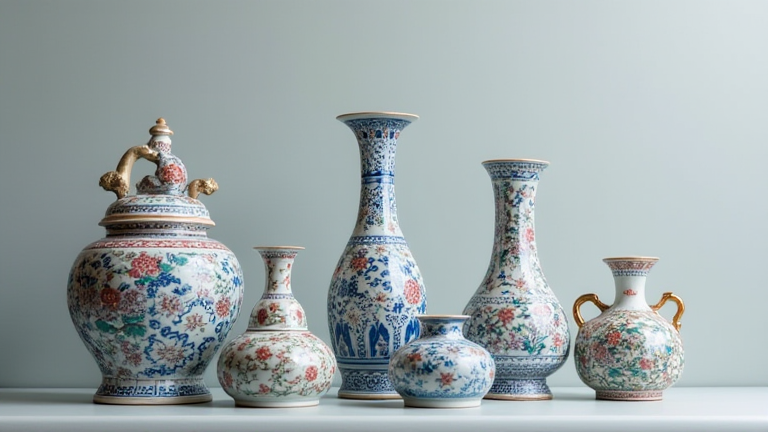
Porcelain History & Culture: A Complete Beginner’s Guide
TL;DR: Porcelain is a fine ceramic material known for its strength, translucency, and ringing quality, originating in China over a thousand years ago. This guide helps you understand its historical evolution, cultural significance, and how to appreciate authentic pieces for your collection.
Understanding the Origins of Porcelain
To begin your journey into porcelain culture, you must first grasp its origins in ancient China. The material, known as “white jade” in Chinese, was perfected during the Tang Dynasty (618–907 AD) but reached its peak during the Song Dynasty. Unlike other ceramics, true porcelain is made from kaolin clay and petuntse, fired at extremely high temperatures. This process results in a body that is non-porous, durable, and uniquely white. Start by studying primary sources on Chinese kiln history to distinguish between earthenware, stoneware, and true porcelain. Understanding these technical differences is the foundation of any serious appreciation of the art form.
If you want to dig deeper, check out our guide on Porcelain History & Culture: A Lifestyle Guide to Timeless E.
Tracing the Global Spread and Impact
Next, explore how porcelain traveled the world and influenced global trade. By the Ming Dynasty, Chinese porcelain became a global commodity, traveling via the Silk Road and later maritime routes to Europe, the Middle East, and Southeast Asia. This export triggered a massive cultural exchange. In Europe, the quest to replicate Chinese porcelain led to the establishment of factories in Meissen, Germany, and Sèvres, France. To deepen your cultural understanding, examine how porcelain designs adapted to local tastes. For instance, “Ming Imari” patterns were inspired by Japanese interpretations of Chinese styles, creating a complex web of artistic influence. Learn to identify these hybrid styles, as they represent the cosmopolitan nature of 17th and 18th-century trade.
Appreciating Aesthetics and Techniques
Now, focus on the aesthetic elements that define different periods and cultures. In Chinese culture, simplicity and natural forms were often prized, with blue-and-white motifs depicting dragons, landscapes, or literary scenes. In contrast, European porcelain, particularly from the Rococo era, favored elaborate gilding, floral garlands, and pastel colors. To develop your eye, study the specific glazes and painting techniques associated with each region. Look for the “ginger juice” glaze of early Chinese pieces or the crisp, bright blue of English bone china. Understanding the symbolic meanings behind specific motifs, such as the lotus for purity or the peacock for immortality, adds a layer of depth to your appreciation of the artwork.
Building and Caring for a Collection
Finally, learn practical tips for building and maintaining a collection. Start with accessible items like tea sets or small figurines rather than expensive vases. Always buy from reputable dealers who provide provenance documentation. When caring for your pieces, handle them with clean, dry hands or cotton gloves to prevent oil stains. Clean them gently with a soft, dry cloth; avoid harsh chemicals or submerging antique pieces in water, as this can damage glazes or repairs. Store porcelain in a stable environment with low humidity to prevent cracking. By combining historical knowledge with careful stewardship, you will cultivate a deep and meaningful connection to this beautiful material.
FAQ
Q: What is the main difference between porcelain and ceramic?
A: Porcelain is a specific type of ceramic that is fired at higher temperatures, making it denser, more durable, and often translucent, whereas general ceramics may be more porous and opaque.
Q: Why is blue-and-white porcelain so famous?
A: Blue-and-white porcelain is iconic because it became the most exported style from China to the West, influencing global taste and serving as a status symbol in European courts during the 16th and 17th centuries.
Q: How can I tell if a piece is genuine antique porcelain?
A: Look for maker’s marks, signs of age like wear patterns, and consistency in the glaze; however
Leave a Reply