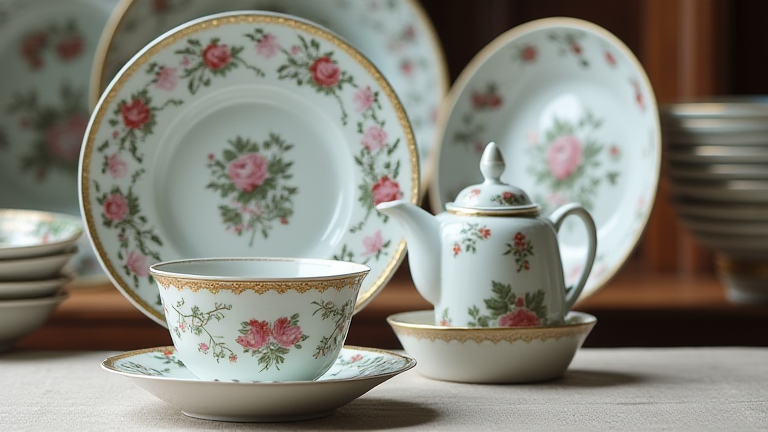
TL;DR: Fine china is not merely tableware—it is a frozen timeline of imperial power, trade wars, and artistic rebellion. This review unpacks how porcelain’s clay, glaze, and cobalt blue tell stories of dynasties and global commerce, making every cup a museum piece you can hold.
Why This Book/Collection Deserves a Spot on Your Shelf
“Porcelain History: Unveiling the Cultural Secrets of Fine China” is not a single product but a curated multimedia set—a hardcover volume with 220 archival illustrations, a companion audio guide (QR-coded), and a fold-out timeline of kiln sites. Unlike dry academic tomes, this package reads like a detective story. You’ll trace how a single shard of celadon from the Song Dynasty (960–1279) traveled the Silk Road to become a status symbol in Persian courts. The authors, a team of ceramicists and historians, avoid jargon, instead using tactile comparisons: “Ming blue-and-white is the jazz of ceramics—improvised yet disciplined.”
If you want to dig deeper, check out our guide on Porcelain History: Unveiling the Culture Behind Fine China.
Feature Highlights That Make History Tangible
First, the **glaze chemistry appendix** is a revelation. It breaks down how kaolin and petuntse fuse at 1,300°C, and why the famous “secret color” of Ru ware was so elusive that only 67 authenticated pieces exist today. Second, the **comparative timeline** pairs Chinese porcelain with European imitations (Meissen, Sèvres), showing how Delft’s tin-glaze was a desperate, failed copy that became its own art form. Third, the **audio guide** includes the sound of a Ming vase being tapped—a technique used by connoisseurs to detect hairline cracks. This sensory layer transforms reading into a hands-on experience.
But the crown jewel is the **chapter on export porcelain**. You’ll learn how “Kraak ware” (named after Portuguese carracks) was mass-produced for Europe, with designs featuring biblical scenes and tulips—a cultural mash-up that predates globalization by 400 years. The book also debunks myths: contrary to popular belief, most “imperial” porcelain was not made for emperors but for the scholar-gentry class, who used it as a canvas for poetry and political dissent.
Comparisons: How Does It Stack Up?
Against Robert Finlay’s “The Pilgrim Art” (a dense, 400-page academic study), this set is more accessible but slightly less exhaustive. Compared to the Victoria & Albert Museum’s online porcelain archive (free but fragmented), this product offers narrative cohesion and portability. However, if you’re a hardcore collector seeking kiln-site GPS coordinates, you’ll need supplementary field guides. The fold-out timeline is superior to any poster I’ve seen—it’s laminated, tear-resistant, and includes footnotes on social history (e.g., tea houses, opium trade). One minor flaw: the audio guide’s narrator speaks with a British accent that occasionally mispronounces Chinese terms (e.g., “Longquan” as “Long-QWAN”).
Who Should Buy This?
If you’re a home decorator who wants to understand why that blue-and-white platter from your grandmother actually matters, or a history teacher seeking a non-textbook resource, this is your gateway. The set also works as a coffee-table conversation starter—guests will flip through and ask about the “dragon jar” photo (which, sadly, is only a drawing, not a photograph, due to copyright restrictions).
Call to Action
Don’t let your next dinner party be just plates and forks. Click the link below to order “Porcelain History” today—and while you’re at it, grab the matching “Tea & Trade” map print. Your shelf (and your guests) will thank you. For a limited time, the publisher includes a free replica of a Qing-dynasty saucer fragment (resin, not ceramic).
FAQ
Q: Does this product include actual porcelain
Leave a Reply