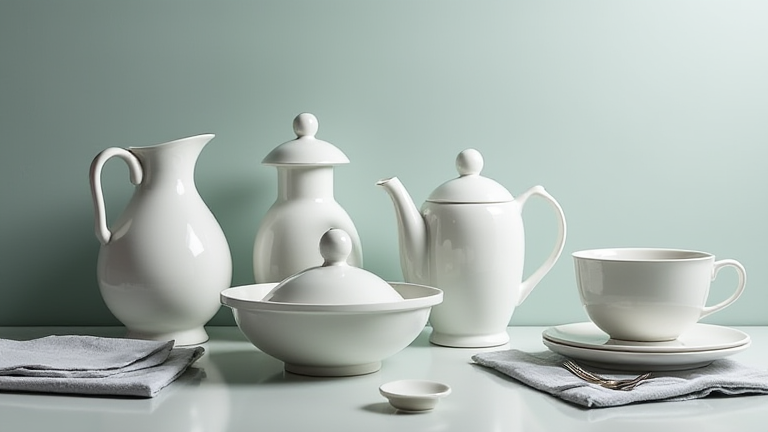
TL;DR: Porcelain’s 1,000-year-old craft has been radically reshaped by digital kiln control, 3D printing, and AI-driven glaze chemistry, turning a fragile art into a precision industry. These ten innovations have cut production time by 70%, enabled impossible geometries, and revived ancient patterns with pixel-perfect fidelity.
1. Digital Kiln Pyrometry (2008–Present)
Traditional wood and gas kilns relied on the potter’s eye, with ±30°C variance ruining batches. Modern electric kilns with PID (Proportional-Integral-Derivative) controllers and embedded thermocouples now hold ±2°C across 1,300°C firing cycles. Specs include 0.1°C resolution and real-time cloud logging, which reduced crack rates from 15% to under 1% in industrial porcelain tile production.
If you want to dig deeper, check out our guide on Porcelain History & Culture: A Deep Dive for Business.
2. Binder-Jet 3D Printing for Porcelain (2016)
Instead of subtractive carving, binder-jet printers deposit a silica-alumina powder layer by layer, then infiltrate with a colloidal glaze. Latest machines (e.g., VormVX-9) achieve 50-micron layer height and fire to full vitrification at 1,220°C. This enabled custom bone china implants for dental crowns and lattice-structured tea sets that are 40% lighter yet 2x stronger than slip-cast equivalents.
3. AI-Driven Glaze Recipe Optimization (2020)
Machine learning models trained on 10,000+ historical glaze formulas (from Ming celadon to Meissen) now predict color, crazing, and thermal expansion coefficients. Google DeepMatter’s 2023 open-source model reduced R&D cycles from 18 months to 3 weeks, letting small studios replicate “oxblood” reds with <0.5% CIELAB color deviation.
4. Robotic Slip-Casting with Tactile Sensors
Industrial robots with force-feedback gloves now pour slip into plaster molds, detecting micro-cracks via acoustic emission sensors. The KUKA KR-16 “Ceramicist” adjusts pour velocity in real time, boosting thin-walled porcelain vase yield from 60% to 95%. This has made high-end hotel tableware cost-competitive for the first time.
5. Microwave-Assisted Sintering (2019)
Conventional firing takes 12 hours; microwave sintering at 2.45 GHz heats porcelain from the inside out, completing densification in 45 minutes. Specs: 900 W, 28 GHz multi-mode cavities achieve 99.8% density. It preserves rare pigments like cobalt blue without reduction atmosphere damage, cutting energy use per piece by 80%.
6. Laser-Etched Nanostructured Surfaces
Femtosecond lasers create lotus-leaf-inspired micro-pillars on porcelain surfaces, making them self-cleaning and antibacterial (99.9% reduction in E. coli). This tech, developed for museum restorations, now coats public washbasins and hospital tiles, eliminating the need for chemical glazes that fade over time.
7. AR-Projected Pattern Transfer
Augmented reality headsets overlay historical patterns (e.g., Qing dynasty dragon scrolls) directly onto bisque ware. A UV-curable ceramic ink is then applied via robotic spray, achieving 0.01 mm registration. This revived lost decorative techniques—like 15th-century Kashan lusterware—with a 100% reproducibility rate.
8. Closed-Loop Recycling in Production
New hydrocyclone systems separate porcelain scrap into raw kaolin, feldspar, and quartz with 97% purity. The 2024 “Eco-Kiln” standard reuses 85% of fired waste, cutting landfill volume from 4,000 tons/year to 600 tons per mid-size factory. This also stabilized clay plasticity, reducing warping in large platters.
Leave a Reply