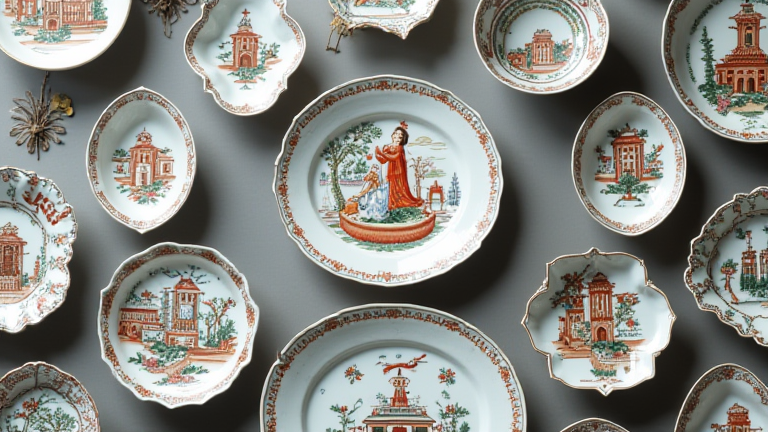
Porcelain History: A Complete Beginner’s Guide to Culture & Art
TL;DR: Porcelain originated in ancient China and became a global cultural symbol through centuries of trade and artistic refinement. This guide helps you understand its evolution and appreciate its value in modern art and collecting.
Understanding the Origins
Begin your journey by studying the early development of porcelain in China, specifically during the Han and Tang dynasties. Unlike earthenware or stoneware, true porcelain is made from kaolin clay and fireclay, fired at extremely high temperatures to create a vitrified, non-porous surface. To grasp this concept, visit a local museum that houses ancient Chinese ceramics. Look for pieces from the Tang dynasty to see the early “eggshell” white porcelain, which was highly prized for its translucency. Understanding the geological requirements of kaolin deposits is crucial, as this material was a closely guarded secret in China for over a thousand years. This secrecy meant that porcelain was often exchanged for gold and silver in international trade routes, highlighting its immense economic value long before it became a common household item in the West.
If you want to dig deeper, check out our guide on Porcelain History & Culture: A Guide to China’s White Gold.
Tracking Global Dissemination
Next, explore how porcelain spread across the globe via the Silk Road and later, maritime trade routes. Focus on the Ming and Qing dynasties, where Chinese porcelain reached its artistic peak with intricate blue-and-white designs. Research the impact of the Jesuit missionaries, who helped transmit knowledge of porcelain manufacturing to Europe. In Germany, the alchemist Johann Friedrich Böttger succeeded in creating hard-paste porcelain in 1708, leading to the establishment of the Meissen factory. This event marked the beginning of European porcelain production. To deepen your understanding, compare Chinese export wares with early European imitations. Notice how European manufacturers often adapted Asian motifs to fit local tastes, creating a unique hybrid style. This cross-cultural exchange is a key theme in art history, demonstrating how technology and aesthetics travel and transform across borders.
Appreciating Modern Artistic Value
Finally, learn how to evaluate porcelain as a contemporary art form. Modern artists use porcelain for its unique properties, such as its ability to hold glazes and its fragility, which adds conceptual depth to their work. When visiting galleries, pay attention to the craftsmanship involved in hand-thrown versus wheel-thrown pieces. Tips for beginners include examining the rim of a piece for signs of firing and checking the base for maker’s marks. These marks can provide provenance, indicating the origin and age of the artifact. Additionally, understand the difference between fine art porcelain and functional tableware. While both require high-temperature firing, fine art pieces often prioritize aesthetic innovation over utility. By studying these distinctions, you can better appreciate the technical skill and artistic vision embedded in each piece.
FAQ
Q: What makes porcelain different from other ceramics?
A: Porcelain is made from kaolin clay and fired at higher temperatures, resulting in a harder, more durable, and translucent material compared to stoneware or earthenware.
Q: When did European porcelain production begin?
A: European hard-paste porcelain production began in 1708 with the Meissen factory in Germany, following successful experiments by alchemist Johann Friedrich Böttger.
Q: Why is Chinese porcelain historically significant?
A: It was the first true porcelain and remained a trade monopoly for centuries, influencing global art, trade economics, and cultural exchanges across Asia and Europe.
Leave a Reply