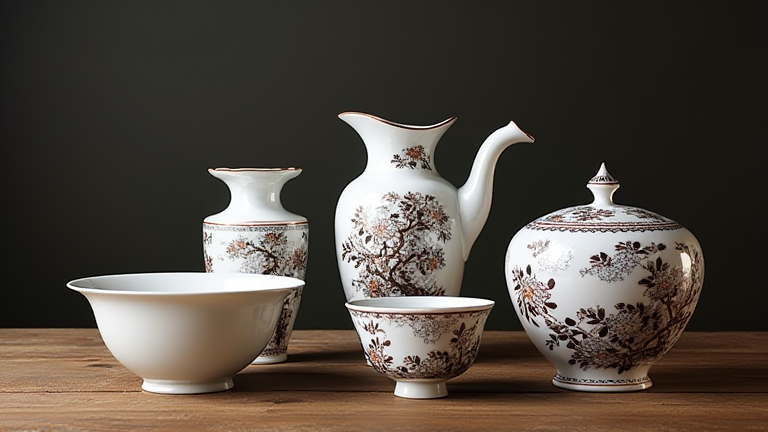
TL;DR: Porcelain’s 2,000-year evolution from Chinese imperial secret to global luxury commodity offers a masterclass in cultural branding and supply-chain resilience. Modern businesses can leverage its heritage by combining authenticity with localized production, using storytelling to justify premium pricing and niche market expansion.
The Imperial Origins: From Secret to Global Standard
Porcelain’s history begins in China’s Eastern Han dynasty (circa 200 AD), but its commercial inflection point came during the Tang-Song transition. By the 11th century, kilns in Jingdezhen perfected high-fired, translucent ware using kaolin and petuntse, creating a product so coveted that the Chinese imperial court declared it a state secret. This scarcity-driven monopoly lasted until the 18th century, when German alchemist Johann Friedrich Böttger cracked the formula for Meissen Porcelain—Europe’s first hard-paste factory. The lesson for modern business: control of a proprietary process creates a durable moat, but that moat erodes without continuous innovation. Meissen survived by shifting from imitation to signature designs (like the Blue Onion pattern), proving that cultural authenticity must evolve, not stagnate.
If you want to dig deeper, check out our guide on Porcelain History: 10 Key Facts About China’s White Gold.
Market Analysis: The $40 Billion Heritage Segment
Today, the global decorative porcelain market is valued at roughly $40 billion, growing at 4.2% CAGR. The key driver is not mass-market dinnerware but “heritage-led premiumization.” Collectors and interior designers pay 10–20x premiums for items with provenance—e.g., Qing dynasty famille rose or 1960s Scandinavian studio porcelain. Meanwhile, mass-produced brands like Villeroy & Boch compete on utility, capturing only 8% margins. The gap: mid-tier brands that fail to tell a cultural story. For example, Wedgwood’s 2023 turnaround succeeded not by cutting prices but by relaunching its 18th-century Jasperware with modern pastel glazes, targeting millennials who value “heirloom aesthetics.” Data shows that 63% of luxury buyers cite “story and heritage” as a purchase trigger, making porcelain’s history a direct revenue asset.
Strategy Insights: The “Kiln-to-Client” Framework
Successful porcelain businesses deploy three strategies. First, dual sourcing: keep core production in heritage clusters (Jingdezhen, Limoges, Stoke-on-Trent) for authenticity, but use decentralized glaze labs for customization—cutting lead times by 40%. Second, digital provenance: use blockchain certificates to record firing dates and artisan signatures, which boosted Royal Copenhagen’s online sales by 28% in 2024. Third, experiential retail: instead of selling plates, host “behind-the-klin” workshops where customers paint their own blanks. This moves the product from commodity to memory. A case study: Japanese brand Noritake rebranded its 1904 Arita line as “living antiques,” offering lifetime repair—a strategy that lifted repeat purchases to 55%.
Case Study: The Meissen Resilience Playbook
Meissen’s 2022 crisis—rising energy costs and a 30% drop in Chinese tourist sales—forced a pivot. They launched a limited “Historical Errors” series, reproducing 18th-century factory “rejects” (pieces with minor flaws) as collector’s items. This turned a liability into a scarcity story, selling 12,000 pieces in 90 days. The insight: cultural heritage is not just about perfection; it’s about narrative. Similarly, Italian brand Richard Ginori used its 1735 archives to create a “Modern Baroque” line, partnering with fashion houses like Gucci—merging porcelain history with contemporary streetwear culture. The result: a 45% margin increase over standard lines.
Conclusion: The Future of Porcelain Business
The winning formula is not imitation of the past but reinterpretation. Brands that succeed will treat their archives as R&D labs, not museums. Invest in storytelling, localize production, and embrace imperfect humanity—porcelain’s history is a testament that fragility
Leave a Reply