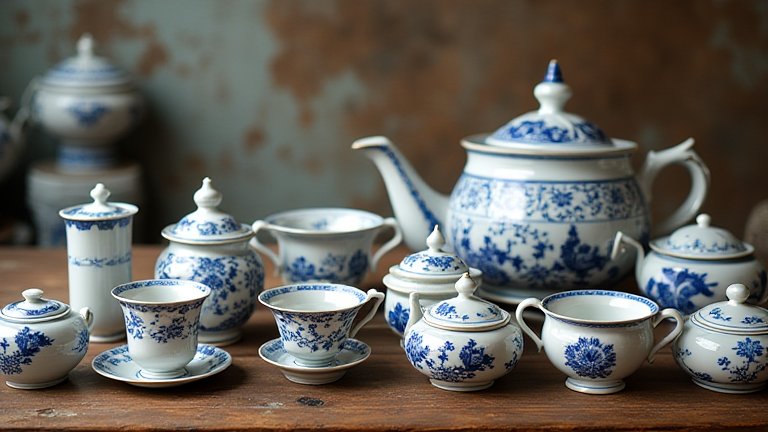
TL;DR: Porcelain is far more than delicate china—it is a 1,000-year-old technological marvel that shaped global trade, diplomacy, and daily rituals. From Chinese kilns to European royal courts, its journey reveals how a single material bridged cultures and redefined luxury.
The Birth of “White Gold” in China
Porcelain emerged during the Eastern Han Dynasty (25–220 CE) in China, but it reached artistic perfection under the Tang and Song dynasties. The secret lay in kaolin clay and petuntse stone, fired at temperatures above 1,300°C, creating a translucent, ringingly hard body. By the Yuan Dynasty (1271–1368), the blue-and-white wares of Jingdezhen became the world’s first global luxury brand, traded along the Silk Road and maritime routes to Persia, Africa, and eventually Europe.
If you want to dig deeper, check out our guide on Porcelain History & Culture: A Complete Beginner’s Guide.
How Porcelain Remade Global Dining & Rituals
In the 16th century, Portuguese and Dutch traders introduced Chinese porcelain to European nobility, who prized it for its imperviousness to staining and its cooling touch. This sparked a cultural revolution: tea, coffee, and chocolate—all new beverages—demanded dedicated cups, saucers, and serving sets. Porcelain transformed social etiquette, creating the ritual of the “tea ceremony” in Japan, the “coffeehouse” culture in Vienna, and the aristocratic dinner service in France. It wasn’t just tableware; it was a status symbol that communicated refinement, wealth, and global connectivity.
The European Obsession & The Secret Recipe
For centuries, Europeans tried to reverse-engineer porcelain, calling it “white gold” for its weight in silver. The breakthrough came in 1708 in Meissen, Germany, when alchemist Johann Friedrich Böttger produced the first hard-paste porcelain outside Asia. This sparked a wave of royal factories—Sèvres in France, Wedgwood in England—each developing distinct glazes and motifs. The craft also traveled to Japan, where Arita and Kutani styles blended Chinese techniques with local aesthetics, creating export wares that influenced Impressionist painters.
Porcelain as Personal Growth & Cultural Memory
Today, collecting or using porcelain is an act of cultural archaeology. Each piece carries a story of migration, conquest, and adaptation—from the Ottoman Iznik tiles to the Art Deco designs of the 1920s. For the modern traveler, visiting a porcelain museum (like the one in Jingdezhen or the V&A in London) is a lesson in patience and imperfection: cracks are repaired with gold in kintsugi, celebrating breakage as history. This philosophy invites us to embrace our own flaws, making porcelain not just a product, but a meditation on resilience and cross-cultural dialogue.
FAQ
Q: What makes porcelain different from ceramic or stoneware?
A: Porcelain is fired at higher temperatures (above 1,300°C) using kaolin clay, making it denser, more translucent, and non-porous compared to earthenware or stoneware, which are fired lower and remain more opaque.
Q: Why was porcelain called “white gold” in Europe?
A: Before the Meissen breakthrough in 1708, Chinese porcelain was so rare and costly that it was traded by weight equivalent to silver or gold, and European alchemists literally tried to turn base metals into this precious ceramic.
Q: How can I start a meaningful porcelain collection on a budget?
A: Focus on modern artisan pieces from local potters, or seek out second-hand “seconds” from historic factories like Meissen or Wedgwood. Look for a single pattern or color story, and prioritize pieces you’ll use daily—this turns collecting into a living cultural practice, not a static display.
Leave a Reply