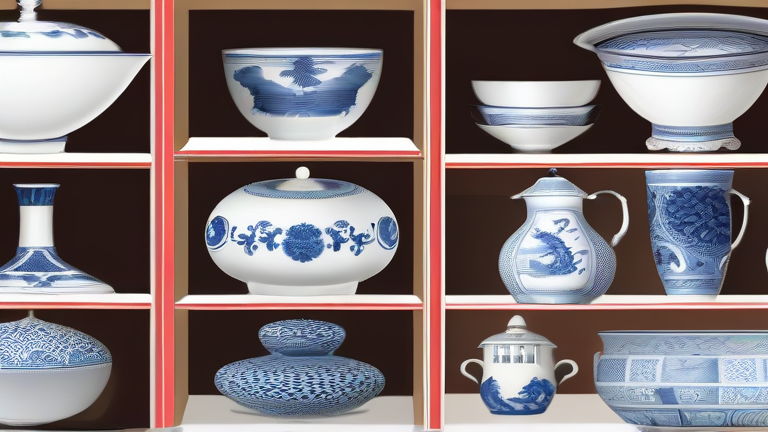
TL;DR: Porcelain is a high-fired, vitrified ceramic born in China around 600–900 CE, prized for its translucency and strength. To understand its culture, trace its trade routes (Silk Road, maritime) and its imitation wars in Europe, then learn to identify key eras like Ming or Meissen.
Step 1: Start with the Chinese Origins (Tang to Yuan Dynasties)
Begin your study in northern China (Gongyi kilns) during the Tang dynasty (618–907), where the first true porcelain emerged from kaolin and petuntse. Move to the Song dynasty (960–1279) for celadon and qingbai wares—look for subtle glazes over painted designs. By the Yuan dynasty (1271–1368), Jingdezhen became the center, producing blue-and-white porcelain using cobalt imported from Persia. Tip: Memorize the five classic Song kilns (Ru, Guan, Ge, Ding, Jun) as a foundation—each has distinct glaze cracking or color.
If you want to dig deeper, check out our guide on **Title:** Porcelain’s Modern Renaissance: How Ancient Craft.
Step 2: Trace the Global Trade and Cultural Exchange
Follow the export routes: first overland via the Silk Road, then by sea during the Ming dynasty (1368–1644). Portuguese traders brought blue-and-white to Europe in the 1500s, sparking a frenzy. Note how local cultures adapted porcelain: Islamic potters copied Chinese motifs, while Japanese Arita kilns (Imari style) added gold and red for Western tastes. Tip: Study the “Kraak” porcelain (irregular panels) that was mass-produced for Dutch ships—it’s a key marker of early global trade.
Step 3: Understand the European “White Gold” Obsession
European aristocrats called porcelain “white gold” and tried to reverse-engineer it for centuries. In 1709, Johann Böttger at Meissen (Germany) cracked the formula, creating hard-paste porcelain. Then came Sèvres (France), Chelsea (England), and Capodimonte (Italy). Each factory developed signature styles: Meissen’s crossed swords, Sèvres’ rose pompadour, and Chelsea’s anchor marks. Tip: Learn to distinguish hard-paste (fired at ~1400°C, scratch-resistant) from soft-paste (lower fire, more fragile)—this alone identifies most fakes.
Step 4: Read the Cultural Symbols and Motifs
Porcelain is a visual language. Chinese motifs carry meaning: dragons (imperial power), phoenixes (empress/rebirth), lotus (purity), and the “hundred antiques” (scholarly aspiration). In European wares, chinoiserie (fantastical Chinese scenes) reflected Western fantasies, not reality. Japanese Kakiemon used asymmetric nature scenes. Tip: Keep a motif dictionary—when you see a figure, check its hand position (e.g., a scholar holding a scroll = knowledge, not decoration).
Step 5: Practice Identification with Modern Eyes
Visit museums or auction sites (not images, but physical or catalog descriptions). Feel the weight: porcelain is dense and rings when tapped. Look at the foot rim—Chinese ware often has a rough, unglazed base; European pieces are usually fully glazed with a factory mark. Tip: Start with broken or late-19th-century pieces (cheap at flea markets) to train your eye before spending on antiques.
FAQ
Q: What is the single most important historical fact about porcelain?
A: Porcelain was invented in China during the Tang dynasty (around 850 CE) and remained a closely guarded state secret for over 1,000 years until Meissen rediscovered it in 1709.
Q: How can I tell real antique porcelain from a modern replica without expert help?
A: Check the base: antiques have unglazed foot
Leave a Reply