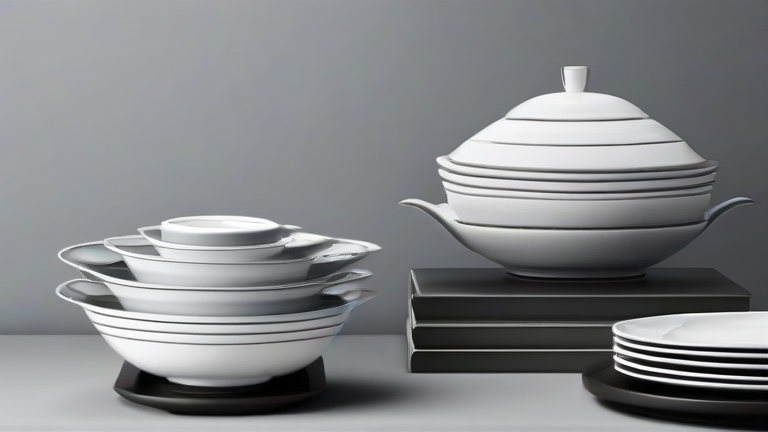
Porcelain History: How Tech Revolutionized Ceramic Craft
TL;DR: Modern technology has transformed porcelain from a centuries-old artisanal craft into a high-precision industrial process by integrating digital design, automated kilns, and advanced material science. These innovations have drastically improved consistency, reduced waste, and expanded the range of possible forms, making high-quality porcelain more accessible while preserving its cultural heritage.
The Digital Renaissance in Clay
For centuries, porcelain production relied on the intuitive skill of master potters, whose hands shaped clay with a precision that took decades to perfect. Today, that tradition is undergoing a radical transformation through the integration of digital fabrication technologies. Computer-Aided Design (CAD) software allows designers to model complex, mathematically perfect forms that would be impossible to create manually. These digital models are then translated into physical reality using 3D printing technologies that utilize specialized ceramic pastes. This shift does not replace the artisan but augments their capabilities, allowing for the creation of intricate, repeatable designs that maintain the aesthetic purity of traditional porcelain while introducing modern geometric complexities.
If you want to dig deeper, check out our guide on Porcelain’s Ancient Roots: A Cultural & Health History.
Precision in Firing and Material Science
The firing process, once a mysterious alchemy of heat and timing, is now governed by rigorous data analytics. Modern kilns are equipped with dense networks of thermocouples and sensors that monitor temperature gradients to the degree. This precision ensures that the vitrification process—the transformation of clay into a glass-like ceramic—is uniform across the entire piece, eliminating the common defects of warping or uneven glaze absorption. Furthermore, advanced spectroscopy and particle analysis have revolutionized material formulation. Manufacturers can now engineer specific mineral compositions to achieve desired opacities, translucencies, and thermal properties. This level of control allows for the creation of specialized porcelain bodies, such as those used in high-end cookware or delicate architectural tiles, that offer superior durability and performance compared to historical standards.
Industry Impact and Cultural Preservation
The impact of these technological advancements on the industry is profound. Production efficiency has increased significantly, reducing material waste and energy consumption through optimized firing schedules and precise material dosing. This efficiency lowers the cost of entry for smaller studios, democratizing high-quality porcelain production. However, the primary benefit lies in cultural preservation. By digitizing historical molds and techniques, archives can preserve fragile heritage designs forever. Younger generations can study and reproduce these forms with exact fidelity, ensuring that traditional motifs and styles are not lost to time. The synergy between ancient craft and modern technology has created a new era of porcelain, where the soul of the material is respected, but its potential is unlocked by the power of data and automation.
FAQ
Q: Does 3D printing replace traditional hand-thrown porcelain?
A: No, it complements it; hand-thrown pieces are valued for their organic imperfections, while 3D printing offers precision for complex, repeatable designs.
Q: How does digital firing improve quality?
A: Automated sensors ensure uniform temperature distribution, preventing warping and ensuring consistent glaze results that manual firing can miss.
Q: Can technology preserve historical porcelain styles?
A: Yes, by digitizing molds and techniques, archives can replicate exact historical forms, ensuring cultural designs are preserved for future generations.
Leave a Reply