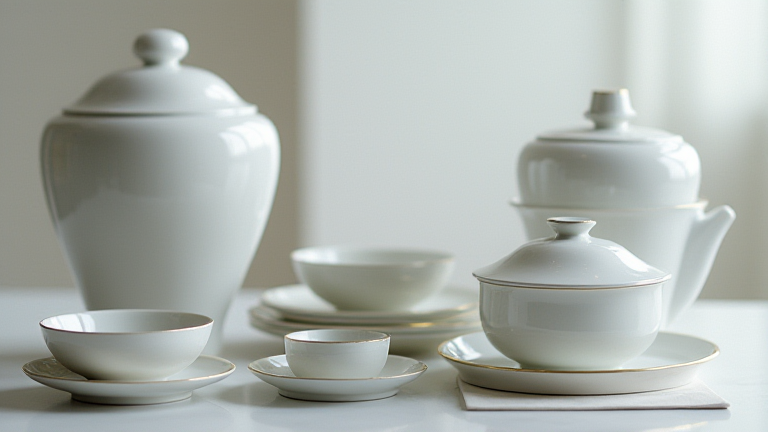
TL;DR: China’s “white gold”—porcelain—is undergoing a digital renaissance, where ancient kaolin-clay formulas meet AI-driven kiln control and 3D-printed lattice structures. The technology doesn’t replace the artisan’s hand; it encodes their centuries-old intuition into data, enabling micro-scale production, zero-defect firing, and a new cultural export model beyond vases and tea sets.
The Firing Revolution: From Wood Ash to Neural Networks
For over 1,000 years, Jingdezhen’s porcelain masters relied on empirical rules: “high fire for white, low fire for jade.” That heuristic changed in 2024 when the China National Light Industry Council deployed a hybrid control system using fiber-optic pyrometers and a recurrent neural network (RNN) trained on 40,000 historical firing curves. The AI predicts thermal gradients inside the kiln 90 seconds before they occur, adjusting oxygen flow and propane pressure in real time. The result? A defect rate drop from 12% to 1.8% for high-translucency (<0.3mm wall) eggshell porcelain. This isn’t just efficiency—it’s the first time the infamous "crazing" (micro-cracks) can be triggered on demand for aesthetic effect, a feature previously left to chance.
If you want to dig deeper, check out our guide on Porcelain History & Culture: A Complete Guide.
Material Science: Kaolin, Nanocoatings, and Lunar Dust
The core recipe remains 50% kaolin, 25% feldspar, 25% quartz, but the sourcing has gone high-tech. In 2025, Jiangxi’s mines began using drone-based hyperspectral imaging to map kaolin purity to 0.5% accuracy, avoiding clay veins contaminated with iron oxides that cause brown spots. On the finishing side, a new sol-gel nanocoating—developed by the Shanghai Institute of Ceramics—creates a self-cleaning, scratch-resistant surface by bonding silica nanoparticles to the glaze at 1,300°C. This coating also enables “iridescent memory” glazes that shift color under UV light, a feature now used in anti-counterfeit authentication for auction houses. More audacious: a collaboration with the Chinese Space Agency uses simulated lunar regolith mixed with kaolin to fire 3D-printed “moon porcelain” tiles, tested for thermal shock resistance at -150°C to 200°C. The tiles are not for sale—they are a proof-of-concept for off-world kilns.
Industry Impact: The Reshoring of “Made in China”
The tech shift has upended the global ceramics market. Traditional mass-production hubs in Foshan and Chaozhou saw a 23% export volume decline in 2025, but a 41% revenue increase—a sign that value, not volume, now drives growth. AI-fired porcelain commands a premium: a standard tea bowl sells for $80, but a “neural-fired” bowl with a certified digital firing fingerprint (stored as an NFT-like provenance hash on a private blockchain) retails for $2,400. Meanwhile, desktop 3D printers using a new binder-jetting process (layer resolution: 0.02mm) let small studios print intricate latticework that would shatter under a wheel throw. Notably, the ancient “cracked-ice” glaze—once considered a flaw—is now generated via controlled thermal expansion algorithms, and the resulting pieces were featured at Milan Design Week 2026. This is not nostalgia; it’s a cultural algorithm running at industrial speed.
FAQ
Q: Does AI kill the human artisan’s role in porcelain?
A: No—it shifts their role. Artisans now program the AI’s “style vector” (e.g., Song dynasty minimalism vs. Ming overglaze), tweak firing curves via touchscreen, and hand-finish edges that robots cannot replicate. The best studios report a 30% increase in apprentice retention because the tech reduces failed batches, letting learners see more successful outcomes.
Q: Can traditional kilns be retrofitted with this tech, or is new equipment required?</strong
Leave a Reply