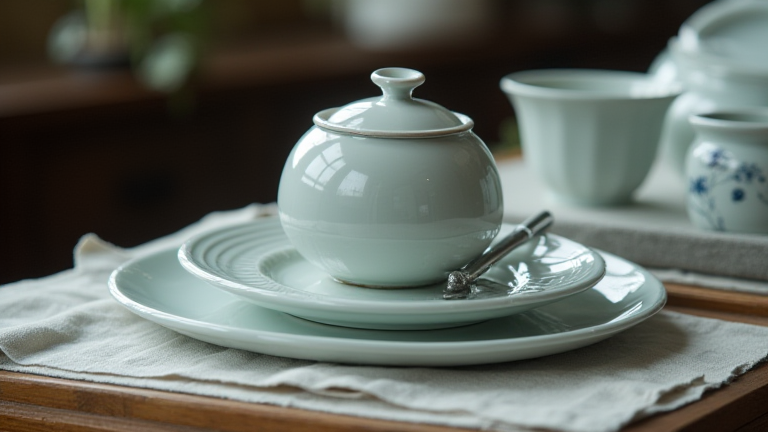
Porcelain History: The Tech Behind China’s Ceramic Mastery
TL;DR: China’s porcelain mastery stems from the precise control of high-temperature firing and unique kaolin clay chemistry, creating a material that is both durable and translucent. Modern developments leverage 3D printing and AI-driven kiln management to preserve ancient aesthetics while enhancing manufacturing efficiency and consistency.
Porcelain, often referred to as “white gold,” represents one of humanity’s earliest industrial breakthroughs. Unlike earthenware, true porcelain is vitrified, meaning the clay body becomes non-porous and glass-like when fired at temperatures exceeding 1,300°C. This technological leap, achieved in China during the Eastern Han Dynasty, allowed for the creation of objects that were not only functional but also possessed a distinctive acoustic resonance and visual elegance. The core of this mastery lies in the specific combination of kaolin, quartz, and feldspar. Kaolin provides plasticity and whiteness, while feldspar acts as a flux, lowering the melting point of the mixture and facilitating the vitrification process that defines porcelain’s unique character.
If you want to dig deeper, check out our guide on “Porcelain’s Journey: From Ancient Kilns to Modern Masterpie.
Latest Developments in Ceramic Technology
Recent advancements have bridged the gap between traditional craftsmanship and modern digital fabrication. One significant development is the integration of additive manufacturing, or 3D printing, into ceramic production. By utilizing slurry-based ceramics that are compatible with extrusion technologies, manufacturers can create complex geometric structures previously impossible to achieve through hand-thrown or slip-casting methods. This technology allows for the precise replication of intricate Ming and Qing dynasty patterns, ensuring historical accuracy while reducing waste. Furthermore, the use of digital twins in kiln operations has revolutionized thermal management. Sensors monitor temperature gradients in real-time, allowing AI algorithms to adjust fuel inputs and ventilation rates dynamically. This precision prevents thermal shock and ensures uniform vitrification, resulting in a product with superior structural integrity and color consistency.
Technical Specifications and Material Science
The technical specifications of modern high-end porcelain have reached unprecedented levels of refinement. The alumina content in the clay body is often optimized to between 30% and 40%, balancing mechanical strength with the desired translucency. The firing atmosphere is strictly controlled; a neutral or slightly reducing atmosphere is maintained to prevent unwanted oxidation of iron impurities, which could discolor the white glaze. Modern glazes are formulated with precise ratios of silica, alumina, and fluxes such as calcium or potassium. The melting point of these glazes is calibrated to be slightly lower than the firing temperature of the body, ensuring perfect adhesion without cracking. The coefficient of thermal expansion is carefully matched between the body and the glaze to minimize stress during cooling, a critical factor in preventing the microscopic fractures that compromise durability.
Industry Impact and Cultural Preservation
The impact of these technological shifts on the industry is profound. Traditional artisans are no longer solely reliant on manual intuition for quality control; instead, they collaborate with data scientists to optimize their processes. This synergy has democratized access to high-quality porcelain, as consistent quality reduces the financial risk associated with high-temperature firing. Moreover, digital archiving of historical forms and glaze recipes ensures the preservation of cultural heritage. By documenting the exact chemical compositions and firing curves of antique pieces, institutions can create reference databases that guide restoration efforts and new production lines. This technological integration does not replace the artist’s hand but enhances it, allowing for a deeper exploration of form and function. The result is a renaissance in ceramic art, where ancient techniques are revitalized through modern precision, ensuring that China’s legacy of porcelain mastery continues to evolve and inspire global innovation in materials science and design.
FAQ
Q: What is the primary technical difference between porcelain and stoneware?
A: Porcelain is vitrified and translucent due to higher firing temperatures and specific clay compositions, whereas stoneware is less vitrified, more opaque, and typically fired at lower temperatures.
Q: How does AI improve traditional porcelain firing processes?
A: AI systems monitor real-time data from kiln sensors to adjust temperature and atmosphere, ensuring uniform
Leave a Reply