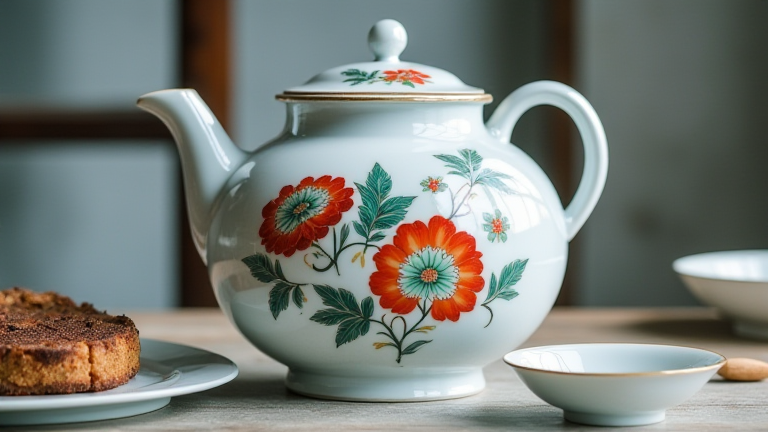
TL;DR: Porcelain’s 2,000-year history is a story of relentless materials science, from Jingdezhen’s high-fired kaolin clay to today’s 3D-printed ceramic lattices. Modern porcelain tech now powers everything from translucent dental crowns and 5G filter substrates to zero-waste cultural collectibles.
From Dragon Kilns to Digital Kilns
Porcelain was the original high-tech ceramic. Chinese potters during the Eastern Han dynasty (25–220 CE) discovered that firing kaolin clay with feldspathic rock at 1,300°C produced a vitrified, translucent, waterproof material — centuries before Europe could match it. The key specs: kaolin (Al₂SiO₅) for plasticity, petuntse (feldspar) as a flux, and iron-poor bodies fired in reducing atmospheres. By the Ming dynasty, Jingdezhen’s dragon kilns held 20,000 pieces per firing, and exported blue-and-white ware became the first true global luxury product.
If you want to dig deeper, check out our guide on Porcelain History & Culture: Tech Behind the Art.
Modern Specs and Manufacturing
Today’s porcelain is engineered, not just crafted. Industrial porcelain tiles boast water absorption below 0.5%, flexural strength of 35–60 MPa, and Mohs hardness of 6–7. Advanced technical porcelain — alumina-toughened or zirconia-reinforced — reaches 300+ MPa for dental and armor applications. Additive manufacturing has arrived: binder-jetting and SLA ceramic 3D printers now produce porcelain objects with 50-micron layer resolution, enabling lattice structures impossible on a potter’s wheel. Meanwhile, low-temperature co-fired ceramic (LTCC) porcelain substrates are standard in 5G RF modules, with dielectric constants tuned between 4 and 9.
Industry Impact and Cultural Products
The global porcelain and ceramicware market is projected to exceed $60 billion by 2030, driven by construction, electronics, and healthcare. In dentistry, monolithic zirconia and lithium-disilicate porcelain crowns — with translucency graded like natural enamel — account for the majority of fixed restorations. In electronics, porcelain’s thermal stability makes it ideal for insulators and filter substrates in 5G base stations. Culturally, the “new Chinese porcelain” movement blends Jingdezhen heritage with parametric design: studios now sell 3D-printed celadon vases and NFT-linked limited editions. Museums use CT scanning and XRF spectrometry to authenticate antiques and 3D-print replicas for handling. Even sustainability benefits: porcelain is inert, recyclable as aggregate, and some studios now fire with hydrogen kilns to cut CO₂.
What Comes Next
Expect self-glazing nanoparticles, porcelain battery separators for solid-state cells, and AI kiln control that predicts glaze crazing before firing. The art world will keep collecting, but the lab will keep leading.
FAQ
Q: What makes porcelain different from regular pottery?
A: Porcelain uses kaolin clay fired above 1,200°C, creating a vitrified, translucent, non-porous body, while earthenware and stoneware fire lower and remain more porous or opaque.
Q: Is 3D-printed porcelain as strong as traditional porcelain?
A: Yes — when properly sintered, printed porcelain reaches comparable density and flexural strength, though layer orientation and binder content must be controlled to avoid weak seams.
Q: Why is Jingdezhen still important to porcelain culture?
A: Jingdezhen remains the global center of artistic porcelain, hosting thousands of studios and supplying the kaolin and craft knowledge that bridge imperial techniques with modern design and technology.
Leave a Reply