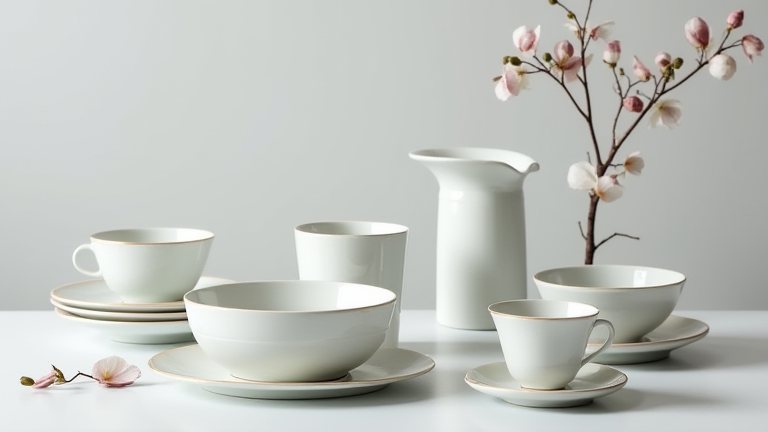
TL;DR: Porcelain, called “white gold” for its prized translucency and strength, was invented in China around 600–900 CE and later became a global luxury that fueled trade, espionage, and artistic imitation. To understand it, you only need to trace its invention, its secret spread, and its cultural impact on dining, decor, and diplomacy.
Step 1: Know the Origins – China’s Secret
Start with the Tang dynasty (618–907 CE), where early “proto-porcelain” emerged from kaolin clay and petuntse (feldspar) fired at over 1,300°C. The real breakthrough came in the Song dynasty (960–1279) with true porcelain: white, hard, and ringing like a bell when tapped. Visit museum collections (online or physical) to compare Song celadon and Qing blue-and-white – note the difference in glaze thickness and cobalt intensity.
If you want to dig deeper, check out our guide on Porcelain History: A Deep Dive into Luxury & Culture.
Step 2: Trace the Silk Road & Maritime Trade
By the 14th century, porcelain traveled via the Silk Road and Indian Ocean routes to the Middle East and Europe. Ottoman sultans and Persian shahs prized Ming vases, often inlaying them with gold or gems. For a beginner, map key trade ports: Quanzhou (China), Hormuz (Persia), and Lisbon (Portugal). Remember that porcelain was not just cargo – it was diplomatic currency, given as royal gifts to secure alliances.
Step 3: Learn the European “Arcanum” Chase
For centuries, Europeans tried to replicate Chinese porcelain, calling the recipe “arcanum.” In 1709, Johann Friedrich Böttger of Meissen, Germany, finally cracked it, producing hard-paste porcelain. Study the Meissen factory’s early marks (crossed swords) and compare them to later Delft (tin-glazed earthenware, not true porcelain) or Sèvres (soft-paste). Tip: Check the base – Chinese porcelain is cold to the touch, while European soft-paste feels slightly warmer.
Step 4: Decode Cultural Symbols & Patterns
Porcelain is a visual language. Blue-and-white willow pattern (actually a British invention) tells a lovers’ tale, while Chinese dragon motifs signify imperial power, and “famille rose” enamels reflect Qing court taste. When studying a piece, ask: Who made it? For whom? What dynasty or factory? For example, cobalt blue on Ming ware came from Persian imports, while “golden” Japanese Kakiemon used overglaze enamels. Use online auction catalogs (e.g., Sotheby’s archives) to practice identifying these motifs.
Step 5: Visit & Handle (or Virtually) with Care
Finally, engage physically. Visit a local museum’s ceramics gallery and note the foot rim, crazing (fine cracks in glaze), and translucency by holding a thin shard up to light. If you buy vintage pieces, check for “chatter marks” on the base (indicating hand-throwing) versus perfectly smooth machine-made modern replicas. Never wash antique porcelain with soap – use lukewarm water and a soft brush.
FAQ
Q: What is the difference between porcelain, china, and pottery?
A: Porcelain and “china” are the same – high-fired (over 1,200°C) with kaolin, making it translucent and non-porous. Pottery (earthenware) fires lower, is opaque, and often needs a glaze to be waterproof.
Q: Why was porcelain called “white gold” historically?
A: Because it was as expensive as gold by weight in Europe before the 18th century – it was lightweight, durable, and impossible to replicate locally, making it a status symbol for royalty and the ultra-rich.
Q: How can I tell if a porcelain piece is old or a modern reproduction?
A: Check the base for wear marks (old pieces show
Leave a Reply