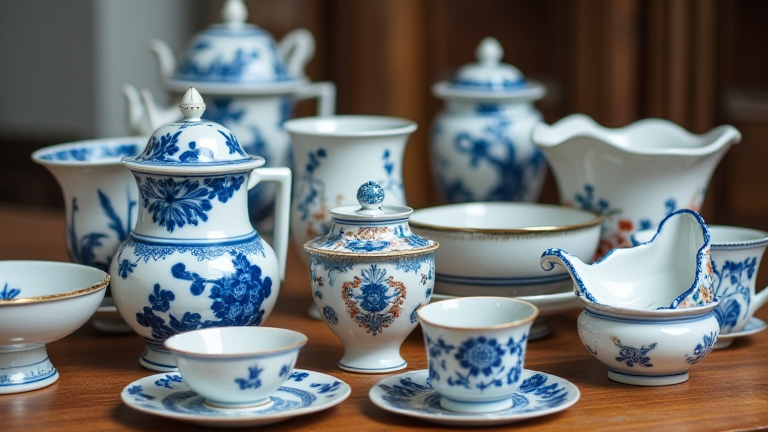
TL;DR: Porcelain is a high-fired ceramic born in China around 600–900 CE, prized for its translucency, hardness, and white body. To understand its culture, trace its evolution from imperial Chinese kilns to European “white gold” factories and its role in global trade.
Step 1: Understand the Three Types of Porcelain
Begin by distinguishing the three main categories: hard-paste (true porcelain made from kaolin and petuntse, fired at ~1400°C), soft-paste (European experiments with glassy frit, fired lower, more fragile), and bone china (British invention adding bone ash for strength and whiteness). Knowing these helps you date and identify pieces.
If you want to dig deeper, check out our guide on Porcelain History & Culture: The Ultimate Beginner’s Tutoria.
Step 2: Trace the Chinese Origins (Tang to Ming)
Start with the Tang dynasty (618–907) for early white wares, but focus on the Song dynasty (960–1279) for celadon and qingbai glazes. Then study the Yuan dynasty (1271–1368) for the first blue-and-white, using cobalt from Persia. For culture, note that Ming (1368–1644) porcelain was imperial-only—decorated with dragons and phoenixes—and exported via the Silk Road. Tip: Check the foot rim; Ming pieces often have a gritty, unglazed base.
Step 3: Follow the Trade Routes and Imitations
Porcelain reached the Middle East and Europe by the 15th century, becoming a status symbol. The Ottoman Empire and Japan (Arita kilns, Imari style) copied Chinese designs. In Europe, the Meissen factory (1710, Germany) cracked the hard-paste formula, followed by Sèvres (France) and Wedgwood (England). Tip: Look for “underglaze blue” versus “overglaze enamel”—the former is older and more durable.
Step 4: Identify Cultural Markers and Marks
Learn the visual language: Kraak ware (loose, paneled borders) for Ming export; famille rose (pink enamel) for 18th-century Qing; gilt and chinoiserie for European fantasies. Check the base for reign marks (e.g., “Qianlong” in six characters) but beware—many later copies carry fake marks. Tip: Use a magnifying glass; genuine marks are hand-painted with uneven strokes, while fakes are often printed.
Step 5: Care for and Collect Porcelain
Handle pieces by the base, not the rim or handles, to avoid stress cracks. Wash in warm water with mild soap, never in a dishwasher, and avoid stacking plates without felt separators. For collecting, start with 19th-century British transferware or 20th-century Japanese Noritake—affordable and plentiful. Visit museums (online collections are free) to train your eye on glaze texture and weight.
FAQ
Q: What is the single most valuable porcelain item in history?
A: The 15th-century Ming “Chicken Cup” (Chenghua) sold for $36 million in 2014—a tiny wine cup with rooster paintings, prized for its perfect glaze and imperial provenance.
Q: How can I tell real porcelain from ceramic or stoneware?
A: Hold it to light—porcelain is translucent (fingers show through) unless very thick. Also, tap it: porcelain rings a high, clear note, while stoneware thuds. Check weight; porcelain feels denser than earthenware.
Q: Why did Europeans call porcelain “white gold”?
A: Because before Meissen’
Leave a Reply