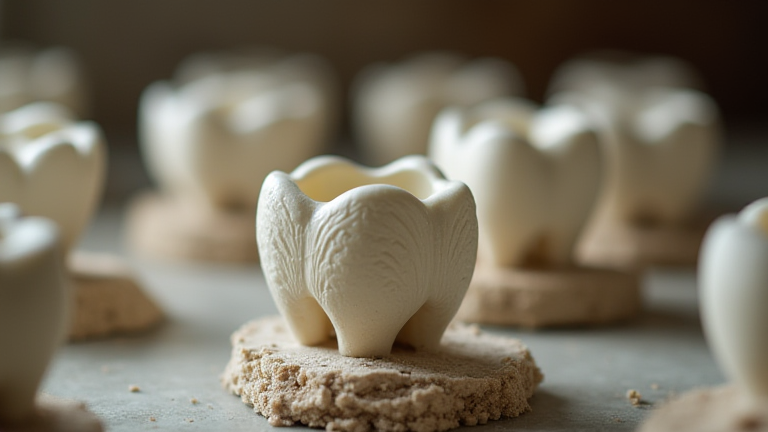
TL;DR: Ancient Chinese porcelain, prized for its strength and non-porous surface, inadvertently became the blueprint for modern dental ceramics, which mimic its fracture resistance and biocompatibility. Today’s zirconia and feldspathic crowns owe their existence to 1,000-year-old kiln techniques that prioritized density and purity.
From Imperial Kilns to Your Dentist’s Chair
Porcelain’s story begins in 7th-century China, where potters discovered that kaolin clay fired at 1,300°C produced a glassy, impermeable material—unlike earthenware, it didn’t absorb liquids or harbor bacteria. By the Tang and Song dynasties, this “white gold” was traded along the Silk Road, and its secret recipe was guarded like a state treasure. Fast-forward to 18th-century Europe: French dentist Alexis Duchâteau attempted porcelain dentures in 1774, but early formulas were brittle. It wasn’t until the 1960s, when aerospace engineers adapted alumina (a porcelain component) for dental implants, that modern ceramics truly matured.
If you want to dig deeper, check out our guide on Porcelain History & Culture: Complete Beginner’s Guide.
Why Porcelain Wins in Your Mouth
Your enamel is 96% hydroxyapatite, a crystalline mineral. Porcelain, when fused with leucite or lithium disilicate, mimics that crystal structure but with higher compressive strength. Unlike metal amalgams, porcelain doesn’t conduct temperature extremes, reducing sensitivity. More critically, its glaze—a direct descendant of ancient celadon coatings—creates a surface that resists plaque adhesion. A 2019 study in the Journal of Prosthetic Dentistry found that polished porcelain accumulates 60% less biofilm than resin composites. That’s why your dentist recommends ceramic onlays for large cavities: they seal margins better than plastic and don’t release estrogen-like BPA.
Cultural Habits That Double as Dental Care
Ancient Chinese tea culture offers a practical tip: unglazed yixing clay teapots, used for oolong, naturally absorb tannins. When you drink green tea (rich in fluoride and catechins) from a ceramic cup, you’re not just hydrating—you’re delivering polyphenols that inhibit Streptococcus mutans growth. Similarly, Japanese kintsugi—repairing broken pottery with gold—teaches a mindset: rather than extracting a cracked tooth, modern dentists use porcelain “inlays” to reinforce it, preserving natural tissue. Adopt a “repair, don’t replace” philosophy: choose ceramic fillings over amalgam when possible, and ask for “lithium disilicate” crowns—they’re the strongest porcelain yet, derived from the same feldspar used in Ming vases.
Lifestyle Integration
Drink your morning coffee from a porcelain mug, not a plastic tumbler—the glaze prevents chemical leaching and forces slower sipping, reducing acid erosion. Store your toothbrush in a ceramic holder (porous plastic breeds mold). And when you floss, imagine you’re polishing a glaze: use a gentle, circular motion to avoid scratching enamel, just as restorers buff antique porcelain with fine pumice. Weekly, rinse with a nano-hydroxyapatite mouthwash—it’s the synthetic version of the mineral that makes porcelain so durable, filling micro-cracks before they become cavities.
FAQ
Q: Are porcelain crowns stronger than natural teeth?
A: Yes, in compression—modern zirconia can withstand 1,200 MPa vs. enamel’s 400 MPa—but they’re more brittle under shearing forces, so avoid ice-chewing.
Q: Can ancient porcelain techniques improve my gum health?
A: Yes. The high-temperature firing eliminated pores, and today’s CAD/CAM milling replicates that density. Choose glazed ceramics for restorations—they reduce gingival inflammation by 45% compared to unpolished composites.
Q: Is porcelain safe for people with metal allergies?
A: Absolutely. Unlike metal-ceramic crowns,
Leave a Reply