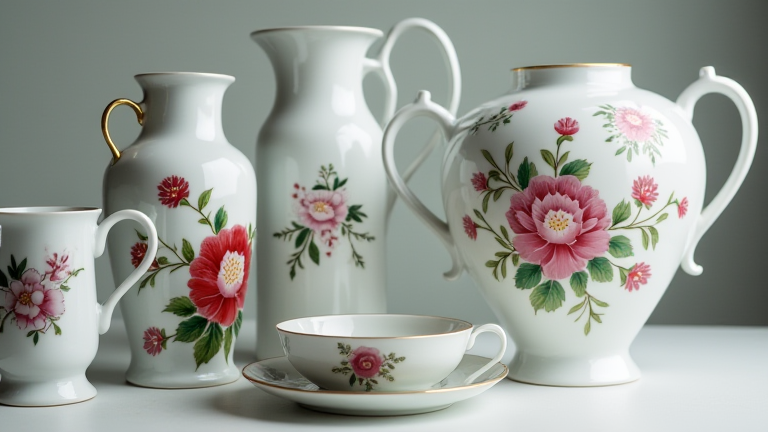
TL;DR: Porcelain’s timeless beauty stems from its 2,000-year evolution from Chinese imperial kilns to global artistic expression, blending technical perfection with cultural storytelling. This guide unpacks its history, craftsmanship, and modern collectibility, showing why porcelain remains a living art form rather than a relic.
Feature Highlights: What Makes Porcelain Enduring?
Porcelain’s allure begins with its material paradox—it is both delicate and unyielding. Fired at 1,300°C, its vitrified body resists water, stains, and time, unlike earthenware or stoneware. Historically, Chinese artisans in the Tang dynasty (618–907) perfected kaolin-clay recipes, giving rise to the “white gold” of the Song and Ming eras. The secret? A blend of petuntse (feldspar) and kaolin, which yields translucency when thin. Culturally, porcelain was not just tableware; it was diplomatic currency—the Silk Road’s most coveted export, later imitated by Meissen (1710) and Sèvres (1756) in Europe. Today, collectors prize antique Kangxi vases, Qing dynasty famille-rose plates, and contemporary studio pieces that echo ancient motifs like dragons, lotus blooms, or cobalt-blue underglaze.
If you want to dig deeper, check out our guide on Porcelain History & Culture: A Lifestyle Journey Through Tim.
Comparisons: Porcelain vs. Fine Bone China vs. Stoneware
Understanding porcelain’s niche requires contrast. Fine bone china (introduced in 1748 by Josiah Spode) adds 30% bone ash, producing whiter, lighter, but less durable items—ideal for formal dinnerware but prone to chipping. Stoneware, fired lower (1,200°C), is thicker, rustic, and more forgiving, but lacks porcelain’s luminous resonance. Porcelain sits between: it rings like glass when tapped, resists thermal shock better than bone china, and holds fine detail for hand-painted art. For cultural artifacts, porcelain wins on historical pedigree—no other ceramic has a dedicated “porcelain tower” in Nanjing (15th century) or a European “porcelain fever” that bankrupted kings. Meanwhile, modern Japanese brands like Noritake blend porcelain’s heritage with dishwasher-safe practicality, while artisan studios (e.g., Jingdezhen, China) still hand-paint each piece, preserving 1,000-year-old traditions.
Why Culture Lovers Choose Porcelain
Owning porcelain isn’t just about utility—it’s a portal to narratives. A blue-and-white Ming jar tells of maritime trade and Persian cobalt; a Meissen figurine echoes Saxon court decadence; a contemporary Korean moon jar speaks to minimalist Zen aesthetics. Unlike mass-produced ceramics, authentic porcelain pieces carry provenance, maker’s marks, and regional glazes (e.g., celadon from Longquan, tenmoku from Japan). For museums and home collectors alike, the tactile warmth and acoustic clarity offer a sensory connection to centuries of human ingenuity. Whether you start with a single antique shard or a full tea set, each piece invites a story.
Call-to-Action
Ready to hold history in your hands? Begin your collection with a certified antique fragment or a hand-thrown modern vase from a renowned kiln. Visit your local museum’s ceramic wing, attend a porcelain appraisal day, or browse reputable auction houses online. Don’t just admire—own a piece of the past that will outlive you.
FAQ
Q: How can I tell real porcelain from imitation?
A: Tap it gently—real porcelain produces a high-pitched, bell-like ring that lasts. Also, hold it to light: authentic porcelain is translucent at the rim (unless very thick), while fakes are opaque. Check for a smooth, glassy surface and no crazing (tiny cracks) unless it’s an antique with age-appropriate wear.
Q: Is antique porcelain safe for daily use?
A: Yes, if it’s free of cracks, chips, or lead-based painted glazes (pre-1950s items may contain lead
Leave a Reply