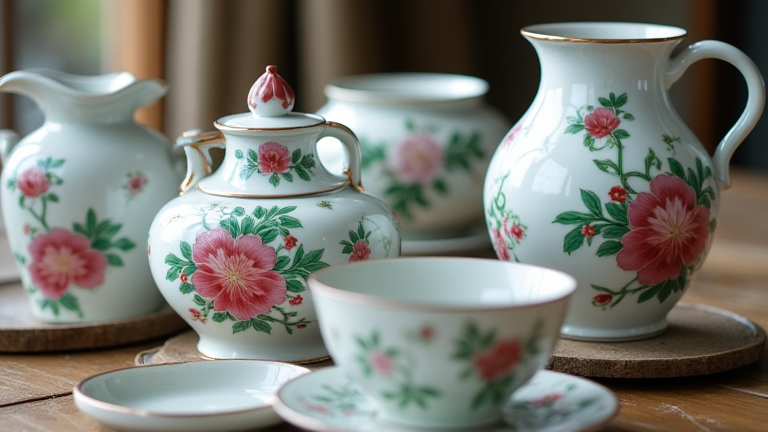
TL;DR: Porcelain is a high-fired ceramic born in China around 2,000 years ago, prized for its whiteness, translucency, and strength. To understand its culture, trace its journey from imperial Chinese kilns to European royal factories, and learn to identify its key traits—body, glaze, and decoration.
Step 1: Grasp the Origins—China’s Gift to the World
Begin with the Tang Dynasty (618–907 CE), where early “proto-porcelain” emerged in northern kilns. By the Song Dynasty (960–1279), true porcelain was perfected at Jingdezhen, using kaolin clay and petuntse (feldspar) fired at 1,280–1,400°C. This created a glassy, non-porous body that rang like a bell. Study the three iconic Song styles: celadon (jade-green), qingbai (pale blue-white), and the later blue-and-white underglaze that dominated the Yuan (1271–1368) and Ming (1368–1644) eras. Tip: Memorize the “four great kilns”—Ding, Ru, Jun, and Longquan—as cultural anchors.
If you want to dig deeper, check out our guide on Porcelain History & Culture: The Ultimate Beginner’s Guide.
Step 2: Trace the Silk Road & Global Trade
Porcelain was not just art; it was currency. From the 9th century, Chinese wares traveled to the Middle East, Africa, and Europe via maritime routes. The Ming dynasty’s export to the Ottoman Empire and Safavid Persia shaped local ceramic traditions (e.g., Iznik tiles). In the 16th century, Portuguese traders brought porcelain to Europe, sparking a “white gold” obsession. Tip: Look for “Kraak” porcelain—thin, blue-and-white export dishes with radial panels—as your first cultural artifact study.
Step 3: Meet the European Imitators & Innovators
Europe failed to replicate porcelain until 1708, when Johann Böttger at Meissen (Germany) cracked the formula. This launched royal factories: Meissen (1710), Sèvres (France, 1740), and Chelsea (England, 1745). Each developed distinct aesthetics—Meissen’s sculpted animals, Sèvres’ pink and turquoise grounds, and Chelsea’s botanical painting. Tip: Compare a Meissen teapot to a Chinese Kangxi vase; note the heavier European foot rim and softer paste, revealing their separate technical paths.
Step 4: Decode Decoration & Symbolism
Porcelain culture is a visual language. Chinese motifs carry layered meanings: dragons (imperial power), phoenixes (empress), lotus (purity), and peaches (immortality). European factories mimicked these but added local stories—pastoral scenes, mythological gods, and floral botanicals. Tip: When viewing a piece, first identify the border pattern (e.g., Greek key vs. wave scroll), then the central scene. This two-step method helps you date and attribute pieces.
Step 5: Handle & Care Like a Curator
Porcelain is durable but brittle. Always support the base and rim when lifting. Avoid dishwashers; hand-wash with mild soap and a soft cloth. For antique pieces, never use abrasive cleaners—they strip the glaze. Store with felt separators to prevent chips. Tip: Check for “crazing” (fine cracks in glaze) as a sign of age, but don’t mistake it for damage—it’s a historical fingerprint.
Step 6: Build Your Beginner’s Collection
Start small: a modern Jingdezhen teacup, a 19th-century English transferware plate, or a contemporary Danish porcelain vase. Visit museum collections online (e.g., the Met’s Asian Art gallery) to train your eye. Attend local antique fairs and ask dealers about provenance. Tip: Buy one piece from a different era each year, not matching sets—this teaches you comparative history faster than any textbook.
<h
Leave a Reply