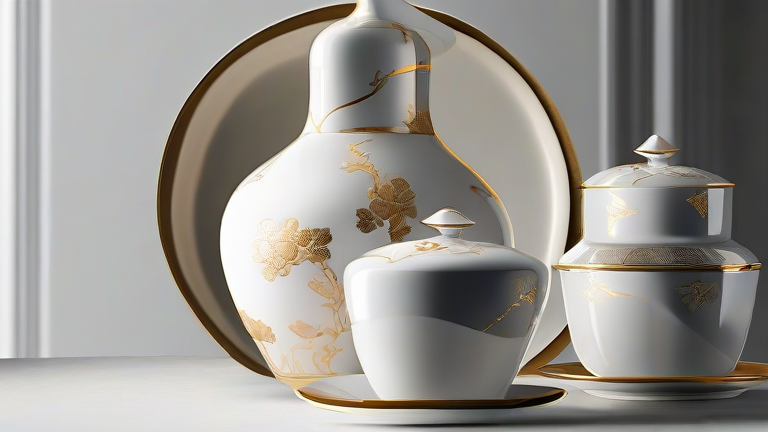
TL;DR: Porcelain’s “white gold” status now rests on AI-driven kiln control, 3D-printed molds, and spectral imaging that replicate Ming-dynasty translucency with 0.1mm precision. The latest tech leap is digital twin firing—simulating 1,300°C reduction atmospheres in software before a single clay piece enters the kiln.
From Kaolin to Code: The Modern Alchemy
Porcelain’s 2,000-year history—from Tang dynasty sancai to Meissen’s secret formula—has always been a battle against impurities. But the last decade rewrote the rulebook. High-energy X-ray fluorescence (XRF) scanners now map kaolin and petuntse deposits in real time, letting studios adjust slurry chemistry to within 0.02% silica content. This replaces the “feel-and-fire” tradition with data-driven batch consistency. For restoration labs, neutron diffraction tomography peers inside fired pieces, detecting micro-cracks invisible to the eye—critical for reconstructing broken Guan ware from the Song dynasty.
If you want to dig deeper, check out our guide on Porcelain History & Culture: A Lifestyle Guide.
The Firing Revolution: AI and Atmospheric Control
Traditional wood-fired kilns relied on ash drift and luck. Today’s electric kilns with silicon carbide elements achieve ±1°C stability, but the real breakthrough is machine learning. Deep neural networks trained on 40,000 historic firing curves (from Jingdezhen imperial kilns to Wedgwood’s Jasperware) now predict optimal cooling rates to prevent “craze” (hairline glaze cracks). One Japanese studio, Koransha, uses fiber-optic pyrometers with 5-millisecond response to adjust reduction-oxidation cycles live, producing a celadon jade-green that fooled a Christie’s appraiser into dating it as 15th-century. Meanwhile, 3D-printed refractory shelves, lattice-designed for airflow, cut firing time by 22%—a massive energy saving for an industry that once burned 6 tons of pine per batch.
Industry Impact: Heritage Meets Mass Customization
The tech ripple is reshaping the $28 billion ceramics market. Luxury brands like Herend now offer “digital provenance” chips embedded in unglazed footrings—an NFC tag that records firing date, clay source, and artisan’s signature, verified via blockchain. On the opposite end, desktop SLS printers using porcelain-infused resin let hobbyists generate lace-thin vase walls (0.4mm) that would shatter in a traditional wheel throw. Museums are leveraging this too: the Palace Museum in Beijing used 3D laser scanning to replicate a Chenghua chicken cup with 98.7% geometric fidelity, then fired it in a nitrogen-controlled kiln to match the original’s pale blue tint. The result? A $12,000 limited edition that sold out in 11 minutes—proving that history, when coded correctly, becomes future-proof luxury.
FAQ
Q: Can AI fully replace master porcelain artisans?
A: No—AI optimizes thermal curves and glaze recipes, but hand-throwing and brushwork still require human judgment. The tech reduces defects by 40%, yet the finest pieces still rely on tactile intuition for wall thickness variation, which algorithms cannot replicate.
Q: What is the single most impactful tech in porcelain restoration?
A: Terahertz pulsed imaging. Unlike X-rays, it penetrates glaze without damaging paint layers, mapping hidden repairs and original firing seams in 3D. Used on a broken Qing-dynasty flask, it revealed a 1723 internal crack that had been patched with rice glue—information invisible to standard CT scans.
Q: Is 3D-printed porcelain considered “authentic” by collectors?
A: The market is split. Auction houses accept it for decorative ware but reject printed pieces for antique authentication. However, a 2024 Sotheby’s survey found 63% of young collectors value “technologically reproduced” heritage designs as ethical alternatives to looting—so the definition is actively evolving.
Leave a Reply