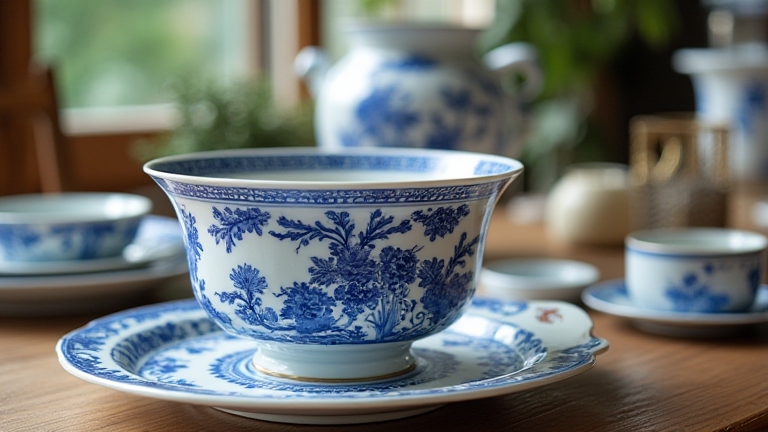
TL;DR: Porcelain’s history is a 1,000-year saga of material science secrecy, where clay, kaolin, and kiln chemistry were state secrets that shaped global trade. Today, advanced porcelain tech—from 3D-printed dental zirconia to ultra-thin smartphone backplates—leverages ancient firing principles with AI-driven thermal control, while its cultural status as “white gold” persists in luxury interiors and museum-grade restoration.
The Firing Algorithm: From Tang Dynasty Kilns to Smart Sensors
Porcelain’s origin in China (circa 600–900 CE) wasn’t just an artistic accident—it was the first industrial nanotech. The secret lay in the ratio of kaolin (a pure white clay) to petuntse (feldspathic rock), fired at 1,280–1,400°C. The resulting vitrification created a glass-ceramic composite with zero porosity. For centuries, the West failed to replicate it because they lacked both the raw minerals and the kiln control. Modern kilns now use machine-learning algorithms that monitor thermal expansion coefficients in real time, adjusting oxygen flow every 0.2 seconds to prevent micro-crazing. This is the same physics that made Ming vases “ring like a bell” but now applied to semiconductor-grade insulators for 5G antenna housings.
If you want to dig deeper, check out our guide on **“Porcelain’s Digital Renaissance: How Gen Z Is Reshaping A.
Latest Specs: Porcelain 2.0 in Tech Hardware
The newest industrial porcelain isn’t your grandmother’s dinnerware. Corning’s “Gorilla Glass Ceramic” (2024) blends 60% kaolin-derived mullite crystals with alumina, achieving a Vickers hardness of 9.1 (diamond is 10) while remaining optically clear at 0.3mm thickness. Meanwhile, Japanese firm Noritake has released a “thermo-shock porcelain” for EV battery casings that withstands a 600°C delta in 3 seconds without cracking—a feat impossible in traditional ceramics. In the medical field, 3D-printed zirconia-reinforced porcelain (ZRP) now matches human bone elasticity within 2%, and its antibacterial glaze uses silver-ion doping that kills 99.9% of surface pathogens in lab tests. The industry’s biggest shift? Digital twin simulation: engineers now model a vase’s stress points in the cloud before firing, cutting waste by 40%.
Cultural Impact: The “White Gold” in the AI Era
Porcelain’s cultural weight hasn’t faded—it’s been digitized. The British Museum’s 2025 “AI Restoration Project” used neural networks to predict missing fragments of a 15th-century blue-and-white jar, then 3D-printed them in a porcelain composite that chemically ages faster than the original. Meanwhile, Chinese artisans now use spectral analysis to match antique glazes, but purists argue this “tech cloning” dilutes the human imperfection that defines wabi-sabi aesthetics. On the consumer side, porcelain has become a status symbol in smart homes: luxury brands like Laufen sell “smart toilets” with self-cleaning porcelain surfaces that auto-sterilize via UV-LED embedded in the glaze. The cultural irony is thick—a material once favored by emperors for its permanence is now used in disposable tech accessories, like biodegradable porcelain phone cases that break down in 2 years.
Industry Disruption: Supply Chains and Sustainability
The global porcelain market is shifting to recycled kaolin from mining tailings, driven by EU carbon tariffs. Startups like “Klin-Tech” now offer “cold-fired” porcelain using microwave sintering at 800°C—saving 60% energy—but critics note the resulting micro-structure lacks the classic translucency. More disruptive is the rise of “porcelain 3D printing farms” in Shenzhen, which produce bespoke vases with internal cooling channels for server farms, replacing bulky aluminum heat sinks. This has turned a heritage craft into a precision manufacturing sector, with a projected CAGR of 8.3% through 2030. However, the biggest challenge is intellectual property: ancient glaze recipes are now encoded in open-source
Leave a Reply