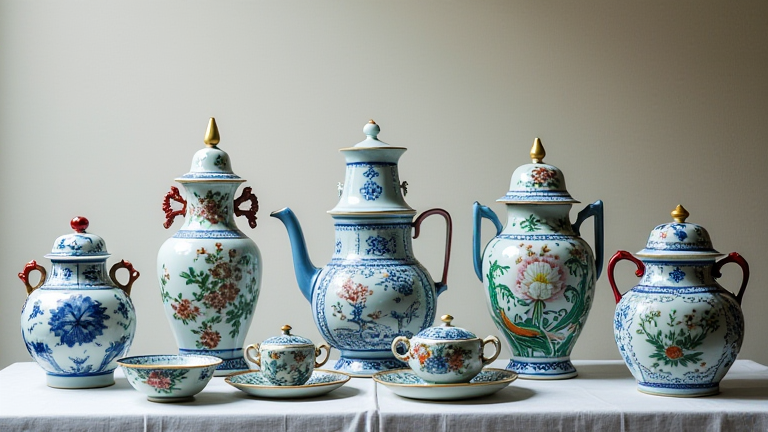
Porcelain History & Culture: The Ultimate Beginner’s Guide
TL;DR: Porcelain is a vitreous ceramic material that originated in China during the Han Dynasty and became a global status symbol through the Silk Road. To understand its culture, you must explore the evolution of glazing techniques, the significance of blue-and-white motifs, and the distinct differences between Chinese, Japanese, and European styles.
Understanding porcelain requires more than just admiring its beauty; it involves grasping the technological and cultural shifts that transformed a local clay into a global commodity. This guide walks you through the essential steps to appreciate this material’s rich heritage. Begin by studying the raw materials. High-quality porcelain is made from kaolin, petuntse, and quartz. Learn to identify these components in museum descriptions or artisan workshops. Knowing the ingredients helps you understand why certain pieces are more durable or translucent than others. This foundational knowledge prevents you from mistaking standard stoneware for true hard-paste porcelain. Always check the base of the item for signs of translucency when held up to a light source. This simple test confirms the material’s purity and age.
If you want to dig deeper, check out our guide on Porcelain’s Tech Roots: How History Shaped Modern Design.
Next, trace the historical timeline to contextualize your collection or study. Start with the Song Dynasty in China, where the first true white porcelain was produced. Note the minimalism of the glazes and the subtle underglaze paintings. Move forward to the Ming Dynasty, which saw the explosion of blue-and-white designs. These patterns often featured dragons, phoenixes, and floral motifs that carried deep symbolic meanings. Understanding these symbols is crucial for cultural appreciation. For instance, a lotus flower represents purity, while a dragon signifies imperial power. Do not overlook the export trade. Study how European potteries, such as Meissen in Germany, attempted to replicate Chinese techniques. The resulting “Sèvres blue” and “Limoges white” are distinct cultural responses to Chinese exports. Compare these styles side-by-side to see how local traditions adapted foreign aesthetics. This comparative analysis reveals the global interconnectedness of art history.
Finally, engage with contemporary culture and conservation. Visit specialized exhibitions that focus on porcelain restoration. Learn about the techniques used to repair cracked pieces, such as Kintsugi in Japan, where gold highlights the cracks rather than hiding them. This philosophy changes how you view damage, turning it into a feature of the object’s history. Additionally, explore modern artists who use porcelain as a medium for social commentary. They challenge traditional views by creating fragile, temporary works that critique consumerism. Attend local ceramic markets to see how traditional techniques are being revived by new generations. Support these artists to keep the cultural knowledge alive. By combining historical research with modern engagement, you develop a comprehensive understanding of porcelain. This holistic approach ensures you view each piece not just as an object, but as a vessel of human history, technology, and artistic expression. Your journey into porcelain culture is continuous, so keep learning and observing.
FAQ
Q: What is the main difference between porcelain and stoneware?
A: Porcelain is fired at higher temperatures, making it more translucent, durable, and non-porous, while stoneware is more opaque and porous.
Q: Why is Chinese porcelain considered the original?
A: China discovered the specific mixture of kaolin and petuntse necessary for true vitreous porcelain centuries before Europe mastered the technique.
Q: How should I care for antique porcelain?
A: Handle with clean, dry hands, avoid harsh chemicals, and store pieces in padded, dust-free containers to prevent chipping or fading.
Leave a Reply