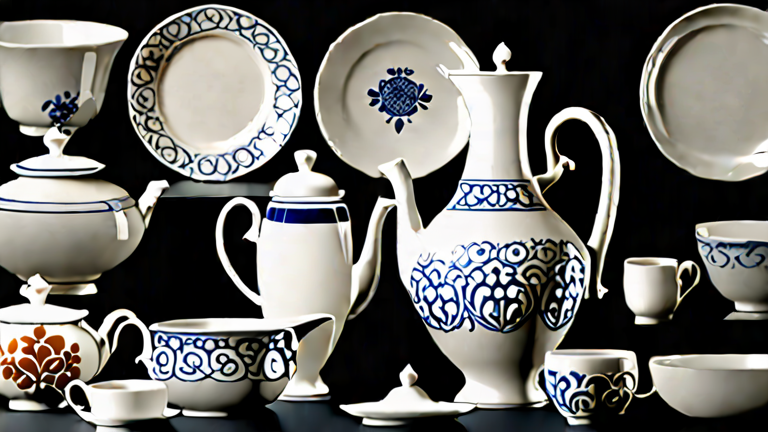
TL;DR: Porcelain is a high-fired ceramic made from kaolin clay and petuntse feldspar, fired above 1,300°C to achieve its signature translucency, whiteness, and ring-like resonance. From Tang dynasty kilns to modern smart manufacturing, this material has driven centuries of technological innovation in tableware, art, and cultural trade.
The Tang Breakthrough That Changed Ceramics Forever
Porcelain emerged in China during the Tang dynasty (618–907 CE), though its roots trace to earlier high-fired stoneware. The key innovation was the kiln technology: wood-fired dragon kilns capable of sustained temperatures above 1,300°C. This allowed potters to fuse kaolin (a refractory white clay) with petuntse (a feldspathic rock), creating a vitrified body with less than 1% water absorption. The result was true porcelain — hard, translucent, and resonant.
If you want to dig deeper, check out our guide on Porcelain History: The Surprising Health Link Behind Its Cra.
From Jingdezhen to Meissen: A Cultural Arms Race
By the Song and Yuan dynasties, Jingdezhen had become the world’s porcelain capital, producing blue-and-white wares using cobalt pigments imported from Persia. These pieces traveled the Silk Road and later the maritime trade routes, becoming diplomatic gifts and status symbols across the Islamic world and Europe. For centuries, China held a monopoly. That ended in 1708, when Johann Friedrich Böttger and Ehrenfried Walther von Tschirnhaus cracked the formula at Meissen, Germany, using local kaolin from Aue. This triggered a European porcelain race — Sèvres in France, Wedgwood in England — and transformed porcelain from an exotic import into a domestic industry.
Modern Specs and Latest Developments
Today’s porcelain is engineered with precision. Standard hard-paste porcelain contains roughly 50% kaolin, 25% feldspar, and 25% quartz, fired at 1,400°C. Bone china, developed in England, adds 30–50% bone ash for greater translucency. Recent advancements include lithium-aluminosilicate porcelain for cooktops and 3D-printed porcelain with complex geometries for architectural tiles. In 2024, researchers in Kyoto demonstrated translucent porcelain with embedded optical fibers, enabling illuminated tableware. Industry impact is significant: global porcelain tableware revenue exceeds $25 billion annually, with automation and digital glazing reducing production waste by up to 30%.
FAQ
Q: What is the main difference between porcelain and bone china?
A: Porcelain uses kaolin, feldspar, and quartz, while bone china adds bone ash for greater translucency and lower firing temperatures, but slightly less durability.
Q: Why is Jingdezhen still important in porcelain history?
A: It has produced imperial porcelain for over 1,000 years and remains a center for artisan and industrial porcelain, preserving traditional techniques alongside modern innovation.
Q: Can porcelain be recycled?
A: Yes, fired porcelain can be crushed and used as aggregate in concrete or as a raw material in new ceramic bodies, though re-firing pure porcelain is difficult due to its vitrified structure.
Leave a Reply