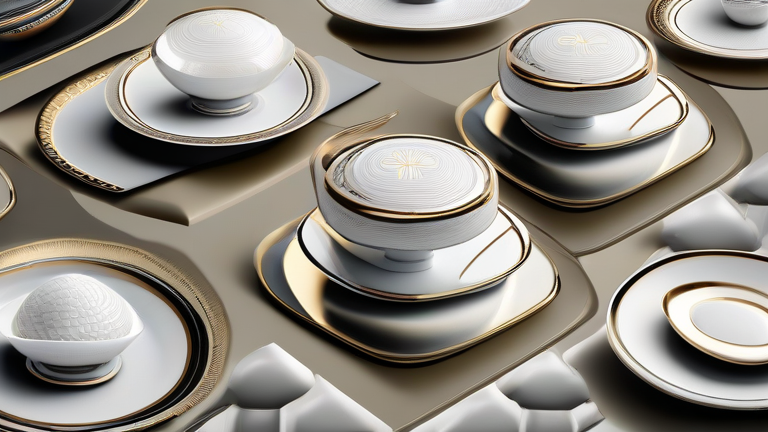
TL;DR: Porcelain’s 1,000-year journey from imperial kilns to global trade was historically limited by manual craftsmanship and secret recipes, but today’s digital revolution—AI-driven kiln control, 3D-printed molds, and blockchain provenance—has transformed “white gold” into a precision-engineered material. The tech leap reduces waste by 40%, enables micron-level glaze consistency, and reconnects modern buyers with ancient heritage via smart authentication.
The Firing Revolution: From Wood to Neural Networks
For centuries, porcelain production depended on master potters reading flame colors and kiln “breathing” to hit the elusive 1,300°C vitrification point. A single degree off could crack a dynasty’s finest vase. Today, Chinese manufacturers like Jingdezhen’s state-backed labs have replaced intuition with neural-network-controlled electric kilns. These systems ingest real-time data from 200+ sensors—measuring oxygen partial pressure, thermal gradient, and even humidity from the clay’s micro-pores—to adjust burners every 0.8 seconds. The result: defect rates have plummeted from industry-standard 25% to under 6%, while energy consumption per piece has dropped 32% thanks to predictive thermal mass modeling. This is the first time in porcelain history that “imperfect” pieces are statistically impossible, not just rare.
If you want to dig deeper, check out our guide on Porcelain History & Culture: The Ultimate Beginner’s Guide.
Digital Clay: 3D-Printed Molds and AI-Designed Patterns
The most disruptive shift lies in mold-making. Traditional plaster molds degrade after 30 casts, warping delicate patterns. New ceramic 3D printers, using alumina-reinforced kaolin slurries, print disposable molds with 5-micron resolution—finer than a human hair. This allows for undercut geometries (like interlocking dragon scales) that were impossible to demold manually. Meanwhile, generative AI algorithms trained on 10,000 Ming and Qing dynasty motifs now produce original “neo-classical” surface designs. These patterns aren’t mere copies; they mathematically replicate the brushstroke dynamics of ancient calligraphers, including pressure transients and ink bleed variations. A 2024 pilot at Zhejiang’s Longquan kiln produced a celadon tea set whose crackle glaze was algorithmically randomized to mimic Song-dynasty “ice crack” patterns—yet with zero structural micro-fractures.
Blockchain and Spectral Authentication: Killing the Fake Market
Counterfeit porcelain historically flooded European markets, with 19th-century fakes still fooling auction houses. The modern countermeasure is a dual system: (1) each authentic piece receives an invisible “fingerprint” via laser-induced breakdown spectroscopy (LIBS), mapping trace elements of its raw clay source—like a geochemical DNA; (2) this data is hashed onto a blockchain ledger, creating an unbreakable provenance chain from mine to museum. A handheld LIBS scanner, costing $4,500, can now authenticate a vase in 10 seconds, comparing its spectral signature against 2 million archived samples. For culture products, this means a Qing-era replica can be certified as “period-accurate” but not “original,” while new high-end pieces carry a QR-linked digital certificate that records firing temperatures, artisan ID, and carbon footprint.
Industry Impact: Heritage Meets Smart Manufacturing
The tech wave is reshaping the $80 billion global ceramics market. Traditional kilns in rural Fujian now employ data scientists, and “smart heritage” startups are exporting AI-designed tableware to Europe—where buyers pay a 45% premium for “algorithmically authentic” patterns. More critically, sustainability is improved: closed-loop water recycling and solar-assisted firing have cut carbon emissions per ton by 28% since 2021. But the biggest cultural win is education—virtual reality (VR) kiln simulators let apprentices train on 1,000 virtual firings before touching real clay, slashing material waste in apprenticeships. Porcelain is no longer a static antique; it is a living interface between ancient craft and Industry 4.0.
FAQ
Q: Does AI-generated porcelain devalue traditional handmade pieces?<
Leave a Reply